
Does my Child need to Testify?

The lawyers may tell you they are going to put your child as a witness in the hearing, or hint that your child is going to need to testify, as if this is the natural process. No. There is no guarantee. They may be trying to scare you into a settlement. Just because they may say your child will testify, doesn’t mean it will happen. It doesn’t mean it’s even a smart move on their part.

If your child is old enough and wants to testify, their testimony can benefit your case. The lawyers may say that they are going to take a lengthy amount of time to cross examine your child but then cut it short when they realize your child’s testimony is helping you and not them. Children speaking to their experience can be very moving and compelling. Tribunal members can end up connecting with your child as they testify. Not something the school districts lawyers want to have happen.

Them hinting at you that your child is going to need to testify can be the very thing that ends up shooting themselves in the foot.

How it works for hearings at the BC HRT, they typically plan for 2 witnesses per day. One in the morning, one in the afternoon. So, if you have 10 people on your witness list, including yourself, you will need at least 5 days to present your case. However, your testimony can take as long as you like. You can have written notes in front of you. (Other witnesses cannot. But because you are self-representing you are allowed.) If you need a full day to lay out your experience and show all of the emails and evidence you have, then you can take it. You can have as long as you need. Then the respondents will have their own people and will need to count their additional days. That gives you the idea how long you will need for your hearing. Some witnesses need more or less time, based on their role. Some of your witnesses will overlap. You will be able to ask questions to all of their witnesses just like they will be able to question all of your witnesses and you.

There are two education cases where the students have testified that I have found. The bullying case and the meaningful inquiry case. I have talked to many parents across Canada, and I have NEVER heard of the tribunal forcing any student to testify.

The tribunal makes their decisions in the best interest of the child. If your child wants to testify, it has the potential of being a positive experience for them. Being in a hearing, isn’t horrifying to all people. It’s horrifying to the people who do bad things. I couldn’t wait to testify. It took me all day to testify. It was liberating. I got everything out of me and it was witnessed by someone with authority.

The tribunal is very good at making kids feel comfortable and giving them accommodations, etc. The lawyers would look like complete assholes if they weren’t sensitive to your child during cross examination. (And they don’t want to come off as assholes to the tribunal member.) This isn’t like court cases that you see in the movies where people are dramatic. You will be in your own home, and it will be online. Your child can be in cozy clothes. You can be sitting beside your child the whole time. They can have fidget toys or do anything else that makes them comfortable.

When you are preparing for a hearing, you will have a pre-conference hearing where you will be discussing the witnesses and their relevance. I highly suggest you ask for an agenda for any conference hearings. That way the respondents wont be able to spring topics on you without your knowledge and you can do some research in advance and just be prepared. If you don’t want your child to testify, you can make your case. How do you think testifying could possibly harm them? And can evidence be entered and cross examined in other formats by other means? There are hearings that have taken place and the student didn’t testify, for example in this 2024 decision.

Making the decision for your child to testify is a decision you both are going to need to make. Don’t feel pressure from the lawyers, that your child will be forced to do something they don’t want to do. It’s easy for adults to make assumptions, thinking that your child wont want to participate. But, kids want to help out other kids too. They want to make a difference. They may also be angry or upset about the harm they went through and this can be a healing experience for them too. Something for them to look back on and think….wow, I did that. It can be a bonding experience for you both.

Keep in mind that hearings can take 2-3 years from the time a failed settlement meeting happens. Your child will be older and may view things differently then what they do now. Don’t make things an issue, until they need to be. People may think that having all this time is a bad thing, but it can actually work in your favour. The time gives your child some space and time away from the situation. Also, gives you lots of time to prepare.
Keeping Your Child’s Information Private

There is a way to keep your child’s information private as you go through the BC Human Rights Tribunal process (BC HRT). If you want to request that something specific happen you can email your case manager and they may tell you that you need to submit an application or they may be able to just respond to your request in the email. If you do send a request you must cc: the school districts in your email. Not every application that you submit will have a public decision, but it’s possible that a decision regarding your process/request could be posted on their website. These applications are things like amending your complaint, joining complaints if you file a family status complaint connected to yourself, fast-tracking, etc.

You can apply for your case to be anonymized. The the BC HRT will anonymize a minors human rights complaint automatically anyways as it is part of their rules, but it is always good to communicate your wishes.

Page 3 of their RULES book

Complaints about minors

(7) In an application to limit public disclosure of information that would identify a minor, the
tribunal will presume that the minor’s privacy interests outweigh the public interest in access
to the tribunal’s proceedings.

Or if you specifically don’t want the district to be anonymized, it’s good to put this in the application and explain why it is in the public interest for them to be identified. (See below for case example) HINT: The school districts REALLY don’t like to be named. You can use it to you advantage to put pressure on a settlement.

The BC HRT doesn’t really advertise this, but if you don’t want to settle and you want a hearing, you can also apply for a “CLOSED” hearing so that no one from the public attends.

IMPORTANT NOTE: I am going to write a blog on this specific topic, but I just want to drop some info. If the school districts lawyers are trying to scare you by saying they are going to force your child to testify and be a witness at the hearing – NICE TRY. Just because they may want them on the witness list, doesn’t mean they are going to get it. The BC HRT makes all of their decisions in the best interest of the child. But the respondents LOVE to dangle this threat as a way to send your protective parent instincts into overdrive. But, more on this later.

How you do either of these options (anonymization and closed hearing) is by filing out an application.

Go to the FORMS page on the BC HRT website.

You will be filling out a 7.1 GENERAL APPLICATION.

You will be asking to anonymize your child’s name. You don’t need to anonymize the districts name, but they will most likely fight for their name to be anonymized too. Their argument is often that it may expose the identity of the child. You can argue back. There are cases where the identity of the child is anonymized and the district is not. Or if that is not something you wish for, you can agree to anonymize the district as well.

Read everything on the form. There is a process that you have to go through before you submit it. You need to contact the school district lawyers and ask them if they agree. They will have to provide you with “their position” on your application. When you email them, I suggest you give them a deadline. Ask them to respond to you within 5 business days.

This is the same form you can ask for a closed hearing. Just tick off OTHER and write “closed hearing” on the PURPOSE OF APPLICATION page. They give you space to answer their questions, but you can always just write “see attached” and then type up your answers. You can submit up to 10 pages.

REMEMBER: They are always going to analyze you through a cost-risk lens. If you become too expensive, they are going to be more encouraged to settle with you. It costs them big money to respond to applications. So if your mediation meeting fails, become expensive.

Here is a list of some decisions around anonymization.

The Student (by the parent) v. The School District, 2025 BCHRT 17

[8]               Rule 5(7) presumes that a minor’s privacy interests outweigh the public interest in accessing the Tribunal’s proceedings. As such, it is appropriate to limit publication of information that could identify the Student in connection with this complaint.

Mother A obo Child B v. School District C, 2015 BCHRT 64

[21]           Rule 5(7) establishes a presumption respecting minors for good reason. Children are vulnerable, in some cases fragile, and those with disabilities even more so. It is difficult enough growing up in the face of existing peer pressure without having the additional burden of adult-driven issues being superimposed in a public way in their formative years. Moreover, these issues may not be readily understood by other children and used as a tool of ridicule and hurt. While some public exposure is inevitable, broad public exposure through unrestricted publication is neither necessary nor in the child’s best interests. At this stage of the proceedings, I find that the privacy interests of Child B outweigh the interests of the public and Child B’s identity and that of Mother A shall be anonymized.

[27]           I note that Mother A alleges that the complaint and future outcome are specific to the policies and practices of this particular district. Further, she says that understanding which district is involved may be important for the public, or future complainants in School District C or other districts. I find that school districts are large public institutions that touch a broad spectrum of the public. The reasons advanced by Mother A for identifying School District C reflect a legitimacy and the sentiment found in para. 11 of the School District 61 case cited above. In the circumstances as they currently stand, I find that there is nothing that outweighs the public’s interest in knowing the identity of School District C and the open court principle.

[28]           Therefore, I am prepared to grant School District C the requested anonymization for the purposes of only this decision. Unless a further order of the Tribunal is obtained, School District C shall be identified in all subsequent proceedings. If the Respondent School District C finds unique circumstances that weigh in favour of its anonymization, it may reapply for such an order.

Child K (by Ehmke) and another v. Queen of All Saints School and another, 2024 BCHRT 150

In this case the mother and child wanted to be named. The school did not want to be named. Child was anonymized until she is an adult and then can apply to have her name added. School lost their application and the decision was to name them.

(29) I appreciate that naming the School could make it easier for motivated and diligent people to identify the people who were involved in the events of this complaint. In that respect, my order will not perfectly protect the people involved. However, I find that – unlike the individual educators and staff involved – there is a specific public interest in the identity of the School as a publicly funded institution serving the public: A obo B v. School District 61, 2014 BCHRT 105 at para. 11. I am not persuaded that this public interest is outweighed by the potential that some of the educators may then be identified. There have already been a number of complaints and proceedings involving the educators and staff, and Mrs. Ehmke points out that many people within the community already know about the complaint.

(30) I deny the application to limit publication of the name of the School.

To search up more decisions, here are instructions on how to use CanLii.

News Articles on Recent Human Rights Partial Win by Parent in Education

January 3rd, 2024

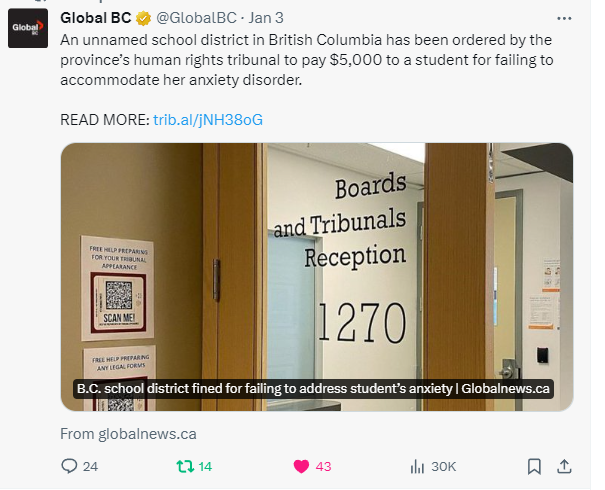
Global BC: An unnamed school district in British Columbia has been ordered by the province’s human rights tribunal to pay $5,000 to a student for failing to accommodate her anxiety disorder.

Vancouver Sun – B.C. school district fined $5,000 for failing to address student’s anxiety

CBC – B.C. school district fined for failing to address student’s anxiety

Global News – B.C. school district fined for failing to address student’s anxiety

National Post – School district must pay $5,000 to student with anxiety, B.C. rights tribunal rules

Chek News – B.C. school district fined for failing to address student’s anxiety

SaskToday – B.C. school district told to pay student $5,000 for failing to address her anxiety

BNN Breaking – British Columbia School District Ordered to Compensate Student with Anxiety Disorder

Cochrane Eagle – B.C. school district told to pay student $5,000 for failing to address her anxiety

Info News – BC high school student gets $5,000 after school ignored their anxiety

City News (Toronto) – B.C. school district told to pay student $5,000 for failing to address her anxiety

City News (Kitchener) – B.C. school district told to pay student $5,000 for failing to address her anxiety

City News (Halifax) – B.C. school district told to pay student $5,000 for failing to address her anxiety

Vancouver Is Awesome – B.C. school district told to pay student $5,000 for failing to address her anxiety

Toronto Star – B.C. school district told to pay student $5,000 for failing to address her anxiety

The Brandon Sun – B.C. school district told to pay student $5,000 for failing to address her anxiety

Ottawa Sun – B.C. school district told to pay student $5,000 for failing to address her anxiety

Edmonton Journal – School district must pay $5,000 to student with anxiety, B.C. rights tribunal rules

Rd News Now (Red Deer) – B.C. school district fined for failing to address student’s anxiety

Meadowlake Now – B.C. school district fined for failing to address student’s anxiety

The Free Press – B.C. school district fined for failing to address student’s anxiety

Castanet Kamloops – B.C. school district fined for failing to address student’s anxiety

The Chronicle Journal – B.C. school district told to pay student $5,000 for failing to address her anxiety

The Hamilton Spectator – B.C. school district told to pay student $5,000 for failing to address her anxiety

Toronto Sun – B.C. school district told to pay student $5,000 for failing to address her anxiety

Ground News – BC high school student gets $5,000 after school ignored their anxiety

The Province – B.C. school district fined $5,000 for failing to address student’s anxiety

Moose Jaw Today – B.C. school district told to pay student $5,000 for failing to address her anxiety

Nelson Star – B.C. school district fined for failing to address student’s anxiety

St. Albert Gazette – B.C. school district told to pay student $5,000 for failing to address her anxiety

Ottawa Citizen – School district must pay $5,000 to student with anxiety, B.C. rights tribunal rules

The Star Phoenix – School district must pay $5,000 to student with anxiety, B.C. rights tribunal rules

Lethbridge Hearld – B.C. school district told to pay student $5,000 for failing to address her anxiety

Rocky Mountain Outlook – B.C. school district told to pay student $5,000 for failing to address her anxiety

Prince George Citizen – B.C. school district told to pay student $5,000 for failing to address her anxiety

Penticton Hearld – B.C. school district told to pay student $5,000 for failing to address her anxiety

Pelham Today – B.C. school district told to pay student $5,000 for failing to address her anxiety

The Canadian Press – B.C. school district told to pay student $5,000 for failing to address her anxiety

Vernon Matters – B.C. school district fined for failing to address student’s anxiety

The Calgary Sun – B.C. school district told to pay student $5,000 for failing to address her anxiety

Comox Valley Record – B.C. school district fined for failing to address student’s anxiety

Times Colonist – B.C. school district told to pay student $5,000 for failing to address her anxiety

Halton Hills Today – B.C. school district told to pay student $5,000 for failing to address her anxiety

MSN – B.C. school district told to pay student $5,000 for failing to address her anxiety

Kamloops Now – B.C. school district told to pay student $5,000 for failing to address her anxiety

Powel River Peak – B.C. school district told to pay student $5,000 for failing to address her anxiety

Maple Ridge – B.C. school district fined for failing to address student’s anxiety

Langley Advance Times – B.C. school district fined for failing to address student’s anxiety

New Westminster Record – B.C. school district fined for failing to address student’s anxiety

Surrey Now Leader – B.C. school district fined for failing to address student’s anxiety

Richmond News – B.C. school district told to pay student $5,000 for failing to address her anxiety

North Shore News – B.C. school district told to pay student $5,000 for failing to address her anxiety

Delta Optimist – B.C. school district told to pay student $5,000 for failing to address her anxiety

The Chilliwack Progress – B.C. school district fined for failing to address student’s anxiety

The Burnaby Now – B.C. school district told to pay student $5,000 for failing to address her anxiety

Mission City Record – B.C. school district fined for failing to address student’s anxiety

Hope Standard – B.C. school district fined for failing to address student’s anxiety

The Squamish Chief – B.C. school district told to pay student $5,000 for failing to address her anxiety

Kelowna Daily Courier – B.C. school district told to pay student $5,000 for failing to address her anxiety

Victoria News – B.C. school district fined for failing to address student’s anxiety

Vernon Morning Star – B.C. school district fined for failing to address student’s anxiety

Town and Country Today – B.C. school district told to pay student $5,000 for failing to address her anxiety

Timmins Today -B.C. school district told to pay student $5,000 for failing to address her anxiety

Bradford Today – B.C. school district told to pay student $5,000 for failing to address her anxiety

*** This is not the full list, but I just can’t keep up.

Law Blogs

HR Law Canada – January 4th, 2024