Why are legal fees that school districts spend SOOOOOOOOO much money on such a mystery???
We already have an OIPC decision that states legal totals do not expose privileged information, so they aren’t protected under the privacy laws. So why the secrecy?
*********
OIPC Decision – Order 1728
[49] For the reasons given above, I find that ss. 14, 17 and 22 do not apply to
the information in issue. Therefore, under s. 58 of FIPPA, I order that the City is
required to disclose the settlement amount and the legal fee amount by August
18, 2015 pursuant to s. 59 of FIPPA. The City must concurrently copy the OIPC
Registrar of Inquiries on its cover letter to the applicant, together with a copy of
the information it provides to the applicant.
**********
Where do you find information that shows their legal spending?
So far that I am aware of, there are two places.
The first one is their Statement of Financial Information that you will find on the main district website under their Board’s financial information section. This is posted every year by December 31st. If they spend over $25,000.00, they have to publicly report it and post it.
The second place is through the Ministry of Finance and the School Protection Program. This is the school’s insurance plan that covers legal fees for human rights complaints. This is where I have been sending my Freedom of Information Requests. If you want to send your own FOI requests, it will cost you $10 and I will write below what I requested. You can file your own and improve on what I have collected.
I first started doing this in 2022. I have just completed another batch. I am a persistent little bugger.
Below are screenshots of the information. However, not very accessible to read. So, I have put everything into an Excel sheet. Kapow!!
The first sheet has the main districts of the Lower Mainland and their legal fees for the last few years from the SOFI. I have mostly focused on the law firm Harris and Company, as they are a very popular law firm for school districts. But there are other law firms that school districts use. The other popular one that is used frequently is Guild Yule and Farris. Then a bunch of other law firms that don’t particularly focus on education but have experience in human rights and insurance.
Below is the link to this document. Click on the different sheets to navigate through all of the data.
I am posting this information because I want this to spark conversation.
What do you think of all of this?
Does it bring up further questions?
What is the difference between the money spent on what is covered by insurance and by what is not?
What is the insurance company’s criteria for what they will cover?
If the district goes rogue and wants to spend their own money on an issue, can and do they do that?
Why don’t we know about any of this?
Why doesn’t the Ministry of Education refuse to keep track of this?
We are talking about MILLIONS of dollars!
Fighting disabled children who are trying to get an education. Schools aren’t fighting parents. They are fighting CHILDREN. The parents are just representing their kids on the complaint. The complainant is the child.
Are we good with this? Public? Hmmmm.
Any thoughts?
Click on the Lawyer Fee Data Sheet to dive in.

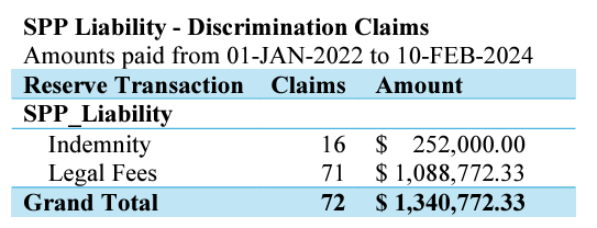
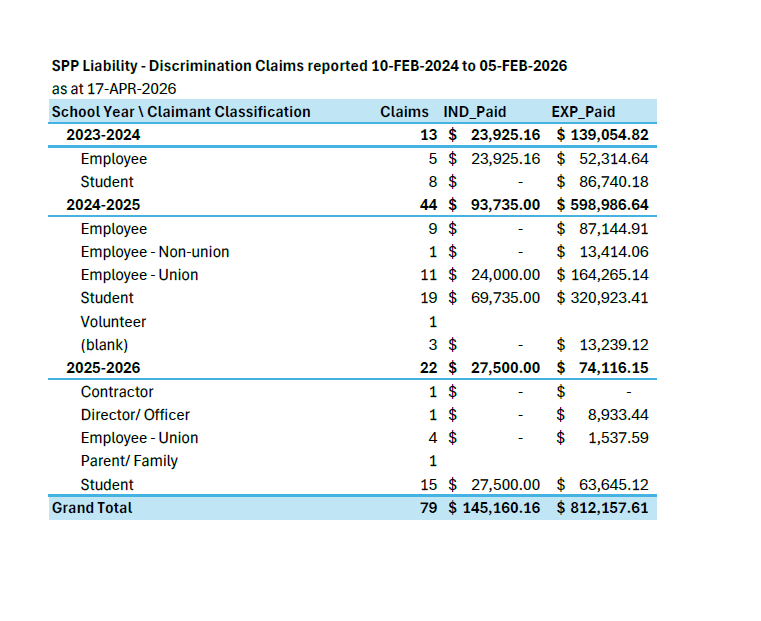
This is what my FOI request on my last one 2024-26
“From the School Protection Program, liability discrimination claims connected to human rights complaints within K12 public schools. The total costs of legal fees and settlement amounts, including how many claims there were for each year (Date Range for Record Search: From 2/10/2024 To 2/5/2026)”
Please use my data as a stepping stone for your own searches.