There is a comedian out there who has a really smart and funny skit. “People will die for their country, but they wont do math for their country.” Dying for your country is easy, doing math is hard.
In concept, heading out into battle for your country is glamorous. People have statues built on their heroics and they get metals. It’s emotionally driven, and adrenaline pumping. Doing math, studying and consistently quietly working hard is unseen, and long term visionary thinking. Systemic change takes years. It takes doing “math” for your community. The building of relationships, the consistent unseen work, and sustainability over time. No statues. Maybe some people recognize your greatness, but it is generally uncongratulated work.
I want to talk about how to advocate for systemic change.
To place myself in this topic: I have a degree in Human Relations from Concordia University, Montreal. This is a degree in how people function in teams, families and organizations and how they can be healthy or toxic.
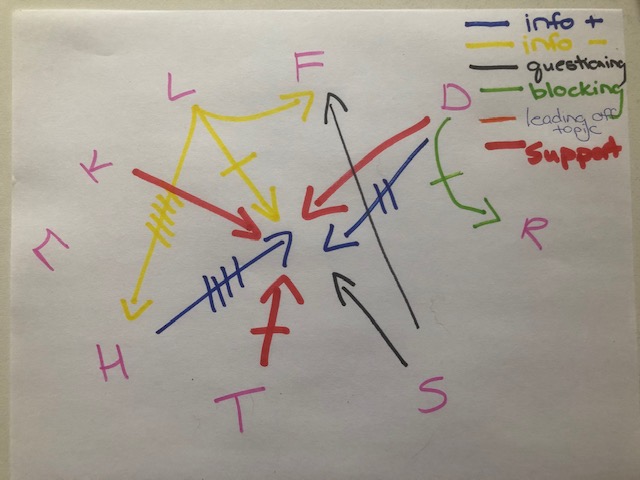
Friction in groups is very important for creativity and productivity. Every team will reach a conflict stage, and when managed well, teams of can be very successful. Having a diverse group of voices, lives experience and expertise is essential for fighting off groupthink. Which is a death sentence for teams that are connected to social policy.
There are open teams. Ones that allow feedback and the external environment to interact with it. Communication will flow in and out.
There are closed teams. Ones that build a wall and lock the doors. An example would be a cult.
It takes a long time to build successfully functioning teams. The most fundamental element to successful groups is TRUST. Firecracker groups start big and are full of energy, but explode and burn out.
Social change requires building credibility and trust with the community as a whole. It requires understanding how everyone is connected. The history of how we got here, what has historically worked and failed. We are all standing on the shoulders of giants who have paved paths for us. We learn from our history, how we have had success, failed, and pivoted. There is an element of risk in being willing to fall flat on your face and get back up and keep trying. Looking for the lessons. Listening to disabled voices in disability advocacy has always been key. Having a growth mindset, humility, integrity, a willingness to fail and keep going is a solid foundation for long term advocacy.
For a social movement, all established community groups need to come together and work together as ONE.
I am reposting my page on Understanding Systemic Change that I wrote years ago, originally on my Speaking Up BC website.
Let’s do “math” for our community and our children.
*******
Some people when they advocate can reach a point when they are beyond frustrated, angry and bitter. Some people have decided to lash out at other people. The very people they are in the trenches with. They end up making it harder and more emotionally draining for parents who are advocating. I don’t think they realize the impact and how upsetting it is for other parents to hear their comments. Crabs in the bucket. My perception is that there is a lack of understanding of how human systems work, and how systemic change occurs and they are frustrated because how they think they should be able to make systemic change occur, isn’t occurring. The wider the gap between our expectations and reality, the more depressed or angry we will become.
I can’t fit everything in this blog about how human systems work, so for this blog I am going to focus on macro-level and micro-level aspects. Macro-level systems are the big ones. The government bodies that include hundreds and thousands of people. They are our political system, the structure of our economy, the structure from the Constitution of Canada and the impact on our system, democracy, our education systems with public schools, private schools, online schools etc. The large groups of multiple moving parts that involve many complex layers, and are maintained by many layers of legislation, policy, and guidelines. Think of many many gears all locked together. They are all moving. Wish to change one gear, and they will all be impacted. These systems have formal codes of conduct and contracts. Also, the unwritten social contracts and social rules that glues everyone together. These systems are tidal wave systems that do not get pushed off course unless something massive happens. I haven’t even mentioned the topic of power. That’s a whole other blog. Systems that are oppressive like to remain that way, unless it’s detrimental to themselves to not change.
Micro-level changes are things that happen on one-to-one individual levels. Individual social interactions. A 20-minute conversation is a micro-level interaction. This is when we advocate with our child’s teacher and they learn something new about ADHD and now they are adapting their teaching and accepting of movement breaks because they understand things differently.
Some people think, that if we only change this one law, or have this one human rights case, or if we change one piece of legislation then everything will be solved for all of the following generations.
I can promise you, if this is how you think, this is where your pain is because that will never happen. Change will never happen because of one person. Ever. We are dealing with way too many macro-level systems all connected and interacting with each other, AND we are dealing with way too many micro-level individual interactions of ableism and lack of information about disabilities. One person is not going to swoop in and solve it all. The education system provincially has hundreds of thousands of people working in these systems. There is not one solution. If we are waiting for a hero to ride in on a horse and save us all, we’ll be waiting for a very long time.
It takes teams. Plural. Many teams. And in our society, it is going to take multiple teams all working together with a common goal for a sustained period of time. These teams are going to have to cover ALL different areas and all different aspects of the multiple gears.
There are 4 elements to a social movement.
- There is a trigger event that inspires an intense reaction from the community
- ALL of the already established community groups come together and work together as ONE
- They have a common simple message that the public can understand. (Eg. Black Lives Matter)
- The advocacy of this one common message and connection of all of the groups needs to be for a long sustained period of time.
.
That is a social movement.
Think of the women’s movement in the 70’s. We still have women’s issues today. But women entering the workforce was quite the shift that started it all off. The different professions women are working in today is because of that social movement.
We need to work at both a macro-level and a micro-level. Even if we had a piece of legislation change or a fantastic policy manual from the government we are still going to be dealing with the individual people who are ableists and want power over. Any change coming from the top down and they will figure out ways to get around it, ignore it, and we will still be struggling with the same shit.
It’s not that we just need to get EA standards and everything will change.
It’s not that we just need to get legislation changed.
It’s not that we just need this one class action human rights case.
We need everyone. We need ALL of it. It is all hands on deck. We need every disability organization, we need all parents, we need trustees, we need educators, we need PAC’s, we need unions, we need everyone working in their own corners advocating for accessibility and inclusion.
Anything less than that, and we will not be able to move the needle enough to notice change in this generation.
It takes a micro-level AND a macro-level response.
Social change, where people really feel that the needle moved, that is noticeable… usually takes 3 generations. But not always…
We are in a catch-22 when it comes to legislation changes. The government won’t enact legislation or funding commitments to items that they feel the majority of their constituents don’t want. Their goal is to get re-elected. If they don’t get re-elected they can’t pursue any of their goals. So, if the public doesn’t care about kids with disabilities and their access to an equitable education…. the government isn’t going to put a massive amount of money into that. They need to make their constituents happy. We also know that society is generally ableist. And oppressive. We are also dealing with evolutionary instincts. Humans are complex. We are a mix of beautifulness and survival instincts. When resources are tight, we want them for ourselves.
Everyone’s advocacy efforts are all part of the work. It all matters. Every single one of you. There is no one single solution or even one single group that is going to just fix everything in a couple of years. It takes massive amounts of people ALL advocating in our own corners. Micro-level and macro-level advocacy work. We can’t just change legislation. We need to change the hearts and minds of everyone to uphold and embrace the legislation even if it does change.
Having said all of this:”Never doubt that a small group of thoughtful, committed citizens can change the world; indeed, it’s the only thing that ever has” -Margaret Mead
Very true. It all starts somewhere. Seeds get planted by small groups that grow over time.
We need the wild risk takers who don’t follow the beaten path, to envision something more, to push past what has ever been done before, to create cracks in the system and allow new growth to occur.
If you are someone who is belittling other parents’ advocacy efforts. Telling them there is no point to any of their work, and that the system will never change. Which is actually impossible, because systems always change. They are maintained by people and society changes all the time. Please, and I say this with love in my heart. Please find counselling or keep your comments to yourself. The human rights process may have been a waste of some people, which I am truly sorry. The human rights system enforces the Human Rights Code and creates the Duty to Accommodate which is the strongest piece of advocacy tools that we have as parents, and those cases that advanced the Code were because of parents who sacrificed. You are not helping anyone by belittling all of parents’ advocacy and telling them there is no point. You are now the one making this worse for them. When you make statements telling people to give up, you are now oppressing them. I have zero tolerance for that.
This is a marathon. Not a sprint.
It’s a team sport. We all need to train individually but run together.
Let’s build each other up and be supportive.
Here are blogs on systemic change.
Systemic Imperfection
Policy – “soft policing”
Groupthink….Does it Exist in School Districts and on Boards of Education
What Does Ableism Look Like in Schools…It Looks Like This!
Who does Society care about?
Why Can’t we Just Sue the Government?
Families are Advocating – A Year in Review for HRT & OIPC and Media
“this family needed help beyond what I’m trained for” (para 58)
Systemic Impacts of Scarcity in Education