Teachers Regulation Branch (TRB) Decision

Here is an important TRB decision about a teacher who was too rigid and the impacts of their rigidity impacting students differently. More so for Indigenous students and neurodivergent students.

“Polishak did not generally adjust his manner of teaching, classroom expectations or assignments to support students’ individual learning needs. A parent of student (“Student A”) asked for Student A to use headphones in class while working on assignments to assist with focus, which is a helpful strategy for students with ADHD. Polishak did not allow Student A to use headphones and did not allow it for some time after the School principal advised him to do so.”

ALSO:

“In the 2023-2024 school year, Polishak generally used rigid classroom rules, which he rarely modified to support the individual needs of all learners in his classes. These rules negatively impacted some students more than others. Over one-third of the students in the School were Indigenous and many of them bussed to and from the School. Polishak’s rules included:

a. Students were required to value all of the class time by not being late. When a student had a history of lateness, Polishak sometimes refused to let the student enter the classroom. Polishak required late students to wait in the hallway for up to 15 minutes, which resulted in students missing more learning time and sometimes falling behind on in-class assignments.

b. Polishak required students to complete all assignments. He did not usually modify or adjust assignments to meet a student’s individual needs. Polishak imposed a “homework detention” on students who had not completed assignments, by which the assignment had to be completed under his supervision before or after school, at lunch or during the flex block.”

There is more to this decision.

Here is the decision in full:

Jonathon Tyler Polishak

Strong Advocacy = Written Authority

School staff have a lot of discretion and power in decision-making related to our children. Not just to their learning but to their socialization. This is given to them by the School Act, other collective agreements, and even human rights decisions uphold their expertise.

At the same time, many of them lack knowledge in education law to fulfil their duties lawfully, and they can easily overstep and make mistakes. This gap in knowledge and a call for more legal training for educators is even written about in education law textbooks. (Education Law in Canada: A Guide for Teachers and Administrators, 2nd Edition. Edited by David C. Young). This book even lacks sufficient knowledge on the Duty to Accommodate, which they admit. This book for 2025, the written content entered was capped at February 2024.

We know that the Human Rights Code supersedes teacher classroom autonomy, but many educators don’t. For some, it is quite the wake-up call when they find this out. Accommodations are required. They don’t get to decide not to provide them because of how they want to run their classroom.

Many of them don’t know the legal obligations around IEPs. They aren’t just words on a page. Many of them are not aware that they can have a Teachers Regulation Branch complaint filed against them if they don’t follow them.

Chances are, if you have read all of my blogs, you will know more about your child’s rights than they will. Which is really a failing for all involved. I don’t think it is fair for teachers to truly not understand what their legal responsibilities are, either. I would feel nervous in that role.

But first, before we dive in: What is written authority?

Written authority is law, policy or some kind of document. Something that is written and acts on behalf of other people, that has power, and people will use it as a decision-making tool. If school staff deny our requests, we always want to ask them something along the lines of: What is the written authority that supports your decision? Basically, says who? Where does it come from? People just can’t just make stuff up.

Staff may feel very confident when making statements. You would swear by their confidence that they are true. Not necessarily. And not that they are intentionally trying to mislead you. Although some people may flat-out lie to you. As I have experienced both.

When they tell us information, especially when it is related to a decision, always ask where that information comes from.

If they tell you that teachers are allowed to _______________________.

Then we can ask them to show us where the written authority is that states they are allowed to do that.

Basically, administrators are very good at spinning stories and making things look very professional. They may legitimately believe what they are saying. We want to cautiously accept what they are saying to us, and always question what they are telling us. We don’t accept vague assertions. How you want to frame your inquiry is up to you. Maybe as a sense of curiosity, and wanting to understand your rights. But you have every right to understand fully where they are coming from, and which written authority they are basing their information on. Sometimes they are correct in what they are telling us, but we also know that the Human Rights Code supersedes policy.

The topic of trust is a layered topic when it comes to education for families with kids with disabilities. We have been hurt over and over again. We know the district operates from a liability lens and they have many obligations connected to staff and the public that go beyond the best interest of our child. We want to believe that they know what they are talking about. But sometimes… honestly…. they just don’t. Or they don’t understand the whole picture.

So what is that zone of trust that we need to enter? Where we can bring ourselves to trust them enought to drop our kids off every day, but also not believe everything they say and be vigilant enough to not assume they are doing everything they can or should for our child?

Ask where that information comes from.

Because you have a lot of written authorities on your side too.

The strongest form of advocacy includes the following: strong documentation, evidence, and written authorities (using law, policy, and other documents created by the school). Follow official internal complaint/advocacy channels. When necessary, file external complaints.

Info to know!

Evidence of Harm
How to Gather Evidence
Email Writing for Schools

Depending on the issue that you are navigating, ground your advocacy in:

  1. Human Rights Law – Duty to Accommodate
  2. School Act & Section 11
  3. Teachers Standards
  4. Students rights
  5. Parents rights
  6. Ministry Policy and Orders
  7. School Board Policy & Administrative Procedures – will be posted on your district’s website
  8. Accessibility Legislation – your district will have its accessibility committee posted on the district website.
  9. Administrative Procedural Fairness (Ombudsperson BC)
    .

Instead of us just taking their word for it, we can ask them to explain

For example: You are telling me they have full autonomy to make discipline decisions. How is the teacher’s discipline decision in line with the Teachers Standard #1?

Or

How has the school’s approach to my child’s IEP development been in line with #4 & #5?

If they have to go in front of the tribunal at the BC Human Rights Tribunal, they will need to provide evidence that they are providing your child with reasonable accommodations. So why not show you this now?

No one anywhere in any profession can just operate in a way or say things that are not grounded in truth, ethics, evidence, or in line with laws and policies. Not nurses, pharmacists, counsellors, car mechanics, engineers, dentists, etc, etc, etc.

We don’t want fluffy conversations that they think they can just float past us and we just accept these without understanding what they are talking about. We don’t accept vague beliefs or opinions. If they are using words that you don’t understand, stop them and ask them to explain. If they state something, we want to know, where is this coming from? Show me.

As you advocate, you will get better and better. You will learn more and more. Your child is getting an education. So are you.

They aren’t breaking you. They are building you. You can take this pile of shit that you are dealing with and turn it into fertilizer.

This stuff isn’t easy. Take it inch by inch. We don’t move mountains in a day. Scream into a pillow and then get to work.

Ask for help!

Here is the school advocacy help directory. These people know their stuff, and they can help you. You don’t need to do this alone. For those who would like to consult with a lawyer, I recommend Kesari Law Corp.

Newsletter – February 1st, 2026

NEW BLOG: February 1st – EMAILS Question & Answer

News from the BC Human Rights Tribunal: User Feedback on Mediations

Noteworthy Facebook Posts: Here are a couple of Facebook posts that are noteworthy enough to send to your inbox on a Sunday…at least I think.

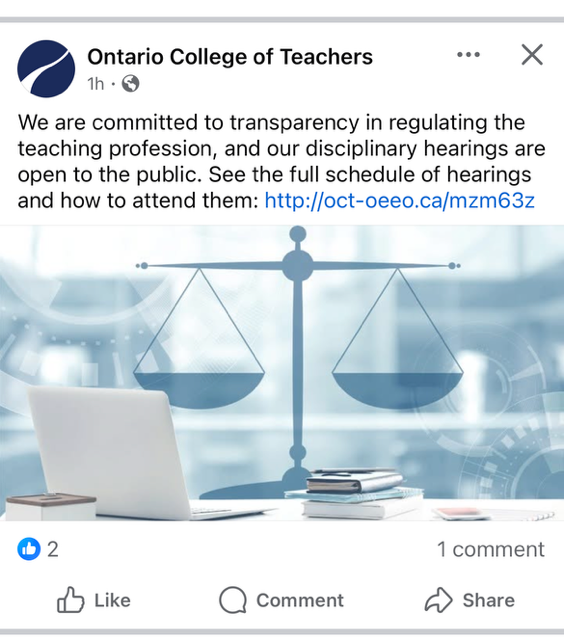
Ontario College of Teachers

This is a Facebook post from the Ontario College of Teachers that was just on my feed this morning.

(ID: Image of Balancing scales, laptop, books with text: “We are committed to transparency in regulating the teaching profession, and our disciplinary hearings are open to the public. See the full schedule of hearings and how to attend them: http://oct-oeeo.ca/mzm63z)

We used to have a teachers’ college in BC, but it was disolved to its toxicity, and the Ministry of Education absorbed it. The Professional Conduct Unit (Teacher’s Regulation Branch-TRB) is a department of the Ministry of Education and Child Care. For people who like to deep dive on the internet on topics, there was a report about it called “A College Divided: Report of the Fact Finder on the BC College of Teachers,” and there were many newspaper articles about how dysfunctional it was and was described as “toxic”.

There is a massive difference between the Ontario Teachers’ College and here in BC. One of the differences I have been dealing with through the OIPC. But that is a story for another day.

The Ontario Teachers’ College is focused on public trust and transparency. I have written previous blogs on my Speaking Up BC website about TRB and how much I do not like how they operate. (I will be combining them and writing a more organized blog in the future.) The websites are an example of how different they are. Ours is a maze, and theirs is clearer important information for parents.

They also give parents a copy of what teachers submit in their defence. Our TRB does not, and the only way to get access to them, so far, is through an application through the BC Human Rights Tribunal. You will only be able to get to apply for those if you have a failed settlement meeting and are going through document disclosure.

Just want to flag this for everyone. Our current regulatory system could be doing a much better job, better aligned with the public and not protecting teachers. They need to prioritize the needs of children, not adults who need professional development help.

I will link some info in the comments.

Here is the report: A College Divided: Report of the Fact Finder on the BC College of Teachers https://www2.gov.bc.ca/assets/gov/education/administration/kindergarten-to-grade-12/reports-and-publications/2010_factfinder_report_bcct.pdf

Ontario College of Teachers website. They even have tab titled “public protection” https://www.oct.ca/en-ca

Our horrible TRB website https://www2.gov.bc.ca/gov/content/governments/organizational-structure/ministries-organizations/boards-commissions-tribunals/commissioner-for-teacher-regulation

Here are some media articles about it.

The Tyee – Behind the Fight Over Who Runs BC’s College of Teachers

City News – BC Teachers College is Dysfunctional

CBC – Report Slams Teachers College

Hello Everyone,

My P.A.T.H website has been a way to share and collect information for parents/caregivers who are advocating for their neurodivergent/disabled children in the K-12 education system.

It has been a labour of love, healing, and peace for me. I am now quite pleased with the collection of information I am able to provide. Finally, I sleep very well at night.

Knowledge is power. Understanding the rules of the system is vital. It is a tough maze we walk through.

I am hoping people will share this information. I would love to see this rights-based information on other websites. It needs wings, and it needs to fly. So, parents, organizations, and other school advocates, I am pleading with you to add information about human rights, external complaint systems, education cases, and advocacy decisions to your own websites. You don’t need to link this back to me. Just take it and run with it. The priority should always be to provide information to support families so that they can support their kids. I don’t view the information on my website as belonging to me. I don’t own it. Take it, spread it and do more with it.

Some people don’t want to engage with lawyers or senior administrators. They feel it’s overwhelming and outside of their capacity. “It’s too much.” If you are advocating, you are engaging with their risk management process whether you want to be or not. I can assure you, the school will certainly be. I say this with my love in my heart, you either learn this stuff at a rate you can handle and try your best, or find an island to live on and unplug from society. There is no escape. They aren’t asking for your consent to participate in their risk management strategies. Because even if the school views you as a “nice, agreeable person” and of no concern, you are still being evaluated. You are just considered low risk. When resources are this scarce, the squeaky wheel gets the grease. I can assure you – you have more in you than you even know.

Rights-based advocacy is our hope and pathway to equity. ❤️

New Teachers Regulation Branch Consent Resolution – Physical Contact

There is a new TRB consent resolution posted, and unless there is something that I think is relevant, I don’t blog about it.

BUT this one is VERY interesting

And here is why. Get a load of this!

From the decision

*******

14. In determining that a reprimand and coursework is an appropriate consequence, the Commissioner considered the following factors:

a. Schubert’s actions in physically blocking Student A escalated the situation.

b. Schubert made physical contact with Student A when it was unnecessary for safety.

***********

Hold the phone.

We are being told by the TRB that if any teacher uses physical contact that escalates a situation and it was unnecessary for safety, they could have a successful TRB complaint against them?

Good to know!

There are situations where adults are physically intervening when safety is not the issue, but as a way to control behaviour, and situations escalate because of it.

Here is your advocacy tool that supports this as wrong, against the Teacher’s Standards and subject to discipline.

Save this decision!

Save. This. Decision.

https://teacherregulation.gov.bc.ca/documents/FormsandPublications/ProfConduct/DisciplineOutcomes/SCHUBERT_CRA_20250911.pdf

For more information on the TRB process and other case examples of where teachers have been disciplined for not following the Teachers Standards when interacting with disabled students, read my TRB page.