Self-Advocacy and Victim Blaming in Education

Self-Advocacy for Students in School

I have put this blog under my IEP category because this is a topic that parents deal with a lot during their IEP meetings. Teachers expect students to self-advocate during IEP meetings. Which can be really hard for kids, under that kind of pressure. They are also very eager to put self-advocacy into IEPs. I often wonder if they think this takes them off the hook, and they are less responsible for implementation. Even outside of IEP meetings, this topic of self-advocacy comes up a lot. The expectations are sometimes unrealistic, and they are creating new problems.

Self-advocacy isn’t easy, especially in an education setting, which is very authoritative, and kids are expected to fall in line.

Certain elements need to be in place to help nurture self-advocacy.

1. The student on some level needs to be accepting of their disability AND be willing to talk about it.

2. They have to be able to identify when they need help.

3. They need to identify what they need help with and have the language/a way to express it.

4. They need a trusted adult who has proved their willingness to listen to them over time.

5. They need to feel heard.

6. They need to feel that this trusted adult will believe them when they say they need help.

7. This needs to be repeated enough times and be predictable enough for the self-advocate to feel comfortable and safe to advocate for their needs.

School staff may say…..

Well _____________ happened, but if XXXX advocated for himself, this wouldn’t have happened.

The reality of the School Environment

Children, since they enter school, are socialized to believe they MUST follow authority, or something really bad is going to happen. They think they will be disappointing all the adults in their lives, and kids deep down just want to make their loved ones love them.

All they want to do is to make the adults (especially their parents but also their teachers) in their lives happy so that they will feel worthy and good about themselves. We need to look at their situation through the lens of a child.

Learning self-advocacy can take a lifetime. Adults have a hard time advocating. We need to have realistic expectations for our children. Especially when they are navigating an oppressive system, based on hierarchy and control. They live in this environment 5 days a week; we don’t. Many times, kids are expressing themselves and their needs, only to end up not being believed.

Children and teens need a safe adult to go to in schools. Someone that they know will help them when they need it. Finding that person and building that relationship can be key. If it’s not the teacher, could it be the counsellor, the case manager, the head teacher, the VP, or another teacher?

BC Human Rights Tribunal – Advocacy

We have a human rights decision on our side.

It’s easy for schools to make us think our kids share responsibility or are responsible for all of it.

Educators may have to be informed of how self-advocacy expectations have been defined by the BC Human Rights Tribunal. In Student by Parent v. School District BCHRT 237.

Remember the power of the Human Rights Code.

[90]           Generally, it is the obligation of the person seeking accommodation to bring forward the relevant facts: Central Okanagan School District No. 23 v. Renaud, 1992 CanLII 81 (SCC), [1992] 2 SCR 970. This can be challenging for children, and especially challenging for children with invisible disabilities. I agree with the Parent that children who require accommodation in their school are in a different situation than adults seeking accommodation. Though they have a role to play in the process, that role will be age and ability-specific, and the burden cannot be on a child to identify and bring forward the facts necessary for their accommodation.

We Learn. They Learn.

Advocacy will always be a part of your child’s life. There will never be a time when they will not be advocating for their own needs. Ask anyone with a disability, doesn’t matter their age, and they will still be advocating for their disability-related needs.

You are modelling what advocacy looks like. When they see you advocate, they learn from you how to do it, but they also learn that they are valued enough and that they are worth the effort. A lot of the advocacy that we do they will never know about. But we often reassure them that we are talking with the school and we are advocating for them.

My kids took notice of my efforts more than I realized. It teaches them to its okay to take up space. You are worth it.

I do have to say, it is very cool to watch your children self-advocate as they grow over the years and become adults. They are always watching and learning. Children have their own timing for things. My children grew into this at different times, and they are still growing as young adults. Of course. Self-advocacy skills never stop. They evolve and grow as we grow.

There are advocacy trainings you can take. Inclusion BC, Family Support Institute and the BC PAC have advertised for advocacy development workshops, along with disability specific orgnaizations, at various times of the year.

The name of the game is learning.

We learn. They learn.

Advocacy is Context Specific

As a self-advocate, I would say my advocacy is very context-specific. My approaches vary depending on who I am talking to, in what environment and situation I am in, and even my own capacity at that moment. I don’t have a memorized statement that I just play over on repeat in situations.

The environment of the education system is a very unique environment, and I tell people, this is a different kind of chess game you are in. It requires a specific skill set and a very specific process. Learning the “rules” of the game in education advocacy will help you greatly.

Internal School Advocacy
External Complaint Avenues
5 Rules on How to be Untouchable
Liability in Education
Understanding Systemic Change
The Duty to Accommodate

BC Human Rights Tribunal Complaint Process – The Blame Game

Do not be surprised that if you file a human rights complaint, the response from the lawyers will be blaming your child for not self-advocating, and that is why the school district is not responsible for their accommodations.

It is a common chess move they make. So, just a heads up.

They will also blame you.

However…..”Parental conduct or lack of parental authority cannot be used as a justification for not meeting an exceptional student’s needs“

We do have case decisions on our side, too – regarding fierce advocacy or lack of it.

We can have respectful conversations and advocate fiercely at the exact same time. It’s not one or the other. Both parties have the expectation to collaborate in good faith as part of the accommodation process. At the same time, our advocacy conduct cannot be used against our child to deny them an equitable education.

********

L.B. v. Toronto District School Board, 2015 HRTO 1622

[77]        The Interim Decision sets out my reasons for issuing an order with respect to the first two points, as follows:

(a)      School boards have an obligation under the Code to accommodate their students with disabilities to the point of undue hardship, regardless of whether the students are receiving any medical treatment in the community or not;

(b)      School boards cannot order or demand of parents to place their children into residential psychiatric treatment programs and cannot deny or withhold accommodations to the point of undue hardship on the grounds that the student should be in such a program. While I have no evidence to show that this was the case here, that does not alter the principle;

(c)      School boards have an obligation under the Education Act to provide appropriate special education placements, programs and services to their exceptional students. Parental conduct or lack of parental authority cannot be used as a justification for not meeting an exceptional student’s needs; and

(d)      I agree with the decision in R.B. v. Keewatin-Patricia District School Board, (R.B./Keewatin) 2013 HRTO 1436, an HRTO decision cited by both parties in this case, at para 265, that a parent’s “fierce advocacy” for his or her child must not and cannot prevent a school board from accommodating the child’s needs to the point of undue hardship.

Trying to Collaborate in Good Faith

Trying to collaborate in good faith and discuss “reasonable accommodations” can be the real murky (stressful) part of the accommodation process that has the most potential for disaster.

This is where we are at our most vulnerable.

Here is why.

(Please read every single word of the next paragraph. Twice if necessary.)

As part of the duty to accommodate, both parties are expected to collaborate in good faith. The accommodations offered by the school don’t need to be perfect or ideal for our children; they just need to be reasonable enough for them to be able to access their education. (Whatever that means.) Even though they have to meaningfully consult with us, the school gets to decide what is reasonable. We need to engage in the accommodation process and have a conversation about whether we think their suggestions for reasonable accommodations are going to work. They have the final decision-making power. Even if we don’t agree, if they draw the line in the sand and say this is it. We have the duty to facilitate that decision. Even if we think it is going to harm our kid. Then if it does harm our kid, we have to document it, and the conversation starts all over again. All the while, we need to be civil and can’t lose our shit. If they frustrate us and we shut down and stop engaging, we will have “frustrated the accommodation process”. In an employment situation, they can have your human rights complaint dismissed. However, this important case [L.B.v. Toronto School Board, para 77 (c)(d)], shows that in the education context, even without parental authority, the school still has to fulfill their legal obligations to your child. Just be prepared, they will blame you for everything if you file a human rights complaint. Well…. they always seem to do that anyway…but still. This case will be helpful.

Sounds fun eh?

If you are ready to rip your hair out, it’s not you. It’s them. They know exactly what they are doing as they drag you onto the hamster wheel and make you run and run and run. (Maybe the teachers aren’t in the know of these strategies, but the admin are.)

There are ways to get yourself off the hamster wheel.

These are not in any order of importance. Just a list of strategies to consider.

  1. Question and document their delay strategies as them not working in good faith. Or any other nonsense they do. You aren’t the only one who has to be collaborative. Delay strategies, ignoring you, dismissing your concerns, is not collaboration. How you question them will be the art of advocacy as to communicate what you are noticing, but not become adversarial.
    • Keep and log every email that they didn’t respond to and every meeting that was cancelled and delayed
    • Keep a timeline for how long things are taking the harm because of the delay
    • Email the list of concerns you have, and note the ones that have not been addressed or have a proposed resolution plan.
    • When you email, you can use the word “notice”. I have noticed that it’s been 3 weeks for us to have a proposed solution to my concerns outlined in my email Nov 12th: Concerns for XXXXX.
    • Another phrase that is good: “It is to my understanding….” And then state what you think, and seek clarification. Is my understanding correct?
    • Email sentences to use: “I am noticing….”, “It is to my understanding that….”, “Is it correct to assume…..” or “I am confused, can you please clarify…..”
      .
  2. Question the reasonableness of their accommodation suggestions – Ask for evidence. Without using the word evidence. If they want to argue that they are providing your child reasonable accommodations to the tribunal, they are going to need to have EVIDENCE to show that.
    • Again, we are using emails as our tool here as documenting is sooooo very important. We absolutely want to communicate in emails. If they don’t want to communicate with you in emails, that is a red flag. (They are up to funky-monkey business, and they know it.) One way of asking for evidence is to say, can you explain to me how this accommodation works for XXXXX? It is extremely reasonable as a parent to want to understand how their plan is going to provide “the ramp”. Ask questions, get them to explain it to you. Don’t let them use vague language. Keep asking questions until you understand exactly what they are talking about. They will use fancy-pancy language with you, hoping to intimidate you. You have every right to understand exactly what they are talking about. If they are not using plain language and instead use jargon, that doesn’t make them look good. What is the point of communicating with each other if we don’t understand what we mean?
      .
  3. Always ask HOW questions. They state your child does _______. Great. HOW does that happen? How. How. How.
    • The tribunal has stated in human rights complaints that the school is in the best position to have discretion to create your child’s education plan, so if they are the experts, then they better behave like the experts. It is their responsibility to investigate why your child is struggling and create a plan on how to remove the barriers. It’s called meaningful inquiry.
      .
  4. File external complaints. Many parents threaten all sorts of things, and quite frankly, not many people do it. They are used to hearing every threat under the sun, and they just sit back and wait for you to explode and leave. If you file a complaint, you will stick out to them. They will underestimate you, until you show them with your behaviour that you are not a doormat. Sometimes, bringing in external eyes and forcing them to provide evidence to someone that they are fulfilling their legal obligations is exactly what needs to happen.
    • All of the external complaint departments are silos. They are VERY specific to the issue you are dealing with. A lot of the time, people could file with all of them as they are possibly dealing with overlapping issues, but not always.
    • To understand which external complaint deals with what issue, please read my page, Resolution Options in Education
    • Also, When should I file?
    • Why does this strategy work? The Damage Period
    • When you should file is basically asking the question to yourself – if, after giving advocacy a chance, what are you willing to tolerate or not tolerate? When will it be enough? Only you can answer that question.
      .
  5. Section 11. In action – not making a decision is making a decision. The School Act Section 11 notes that a lack of a decision is still a decision. If the school is making a decision that “significantly affects the education, health or safety of a student,” you can appeal to the Board of Education.
    • To read more about this INTERNAL advocacy route, please read my page Section 11 – Appeal to the Board of Education
    • Telling the superintendent that you intend to file a Section 11 appeal should at least get you meetings with people in upper management.
    • Not many parents complain past the principal. So again, pulling in district eyes to your child’s school may be necessary. Some principals think they are untouchable. Sometimes we need to remind them that everyone has to answer to someone. It’s kind of how our society works. No one should be untouchable.
      .
  6. Leave if you can. This is an absolute option to consider. There are a lot of parents who feel that if they leave, then “they will win”. This is the emotional well-being of your child. The best revenge is living well. This isn’t a competition. Take your kid and give them something better. Sometimes the fight is worth it, and sometimes it is not. There is nothing wrong with making your child and yourself the priority. They don’t deserve your energy. There is nothing wrong with moving schools or considering other learning options.
    • I say this as someone who is an absolute fighter. My kids were getting better care when I started filing complaints than compared to when I wasn’t. So, for my situation, it was absolutely worth it to stay. Filing complaints is a form of advocacy to push the line, create needed data and change. We need people willing to get in the ring. At the same time, if you need permission to save yourselves and focus on the health of your family, you have got it. I’ll absolutely give it to you. Depends on what your history is or current life issues, sometimes fighting the abusive people in the education system isn’t your journey to take. In the same breath, “Sometimes it is the people no one can imagine anything of who do the things no one can imagine.” ― Alan Turing.
    • No one else can make this decision but you. These aren’t easy decisions as they will impact your child, your family, and you. People just want to be told what to do. I can’t tell you what to do. This is your family, your life. Only you will experience and witness the benefits and consequences of your decisions. Whatever you decide, I hope you find peace.
      .

In summary, the collaboration process can be a case-by-case part that isn’t written in stone and will be very specific to your child. For this reason, there isn’t a cookie-cutter instruction manual on what exactly you need to be doing next. Some people are very collaborative and other people are focused on control and are not collaborative at all. A lot of it will depend on your own resources, perception, values, priorities, and personal situations. For that reason, the uncertainty causes families a lot of stress, and they are terrified of making a mistake. I absolutely encourage you to reach out to support groups, counselling, advocacy coaches and non-profit organizations that offer support. Don’t do this alone. You want to lessen your suffering? Reach out to others. You have a community out there who can sit in front of you and say “me too”.

Why Can’t we Just Sue the Government?

Good question!

Many parent(s)/guardians are asking this question. What they are experiencing in the education system is mass systemic discrimination and they are wondering how in the world is this allowed to happen?? Doesn’t the Charter protect our rights?

Let’s tear this question to bits.

Why can’t we just sue the government?

Funding

  1. A large majority of parents who want to sue the government is because of lack of funding. They want more money from the government to be spent on their children.
    .

When you sue the government it needs to meet a specific legal test. We can’t just sue for lack of funding. If we could, any non-profit organization that felt they weren’t getting enough funding would be suing. That would be all of them. All non-profit organizations of marginalized community groups need more funding and feel they are never getting enough to service their community who are facing lots of discriminatory situations. They are all understaffed. All competing for grants. All desperate. All good and worthy causes. All justified. Yet still… not getting the funding to meet the needs of their community. Keep reading, I’ll explain further.

Quality of Life

2. Something to keep in mind, the government doesn’t owe us a certain standard of living. There is no legislation or law on this. We know this because people are sleeping on the streets and they can’t sue the government for being in that position.

Democracy & Charter of Rights

3. Our government works as a democracy. The system that we have to express our dislike over how the government spends our money, is through voting, contacting your MLA, or peaceful protesting. Other social movement activities like signing petitions, or starting your own non-profit organizations to work with other community members to advocate are all “system” approved ways of furthering your cause. As we will read below in case law, courts will not tell the government how to spend their money when it’s connected to resources in dealing with inequity. The government is allowed to take a “one-step” at a time approach when addressing issues of inequality. They are allowed to determine how to spend society’s limited resources and create social policy when choosing between disadvantaged groups. Something to keep in mind, our system is set up as a separation of powers between the government and the court system. The “conversation” that happens back and forth between courts and the government creating laws is often referred to as the democratic dialogue. See the two Supreme Court of Canada decisions related to Charter Challenges below.

Newfoundland (Treasury Board) v. N.A.P.E., 2004 SCC 66 (CanLII), [2004] 3 SCR 381

[75] [I]t is not realistic for the Court to assume that there are unlimited funds to address the needs of all.”

[79] While purely financial considerations are not sufficient to justify the infringement of Charter rights, they are relevant to determining the standard of deference for the test of minimal impairment when reviewing legislation which is enacted for a purpose which is not financial.

[83] It is also clear that while financial considerations alone may not justify Charter infringements . . . governments must be afforded wide latitude to determine the proper distribution of resources in society . . .  This is especially true where Parliament, in providing specific social benefits, has to choose between disadvantaged groups . . . .

Fraser V. Canada [2020] SCC 28

[ 207 ]                      Governments must be afforded the latitude to act incrementally when addressing a deeply ingrained, complex and persistent social phenomenon such as inequality. (This assumes that the inequality arises from factors in society; where the government itself has created the inequality, matters are, as we have already indicated, somewhat different.) There are processes by which a government must set its priorities, allocate its budget, and obtain parliamentary approval of its programs. In designing legislation to address a particular equality issue, a government can draw on far more internal and external expertise than we judges can. As a result, it is better positioned than we are to appreciate the consequences of a particular course of law‑making, both upon society and upon public resources. With these practical realities in mind, we must also recognize that, were a government expected to remove all inequalities for all groups on every occasion it acted, it may be disinclined to act, given that any remedial scheme will inevitably be under‑inclusive in some respect. Governments would, understandably, become “reluctant to create any new [remedial] benefit schemes because their limits would depend on an accurate prediction of the outcome of court proceedings under s. 15(1) of the Charter ” ( Egan v. Canada , [1995] 2 SCR 513, at para. 104, per Sopinka J.).

[ 208 ]                      To avoid this chilling effect, and to encourage governments to enact remedial legislation addressing pre‑existing disadvantage, this Court has (until now) judiciously accepted that governments may implement reforms “one step at a time, [and] address[s ] [the reforms] to the phase of the problem which seems most acute to the legislative mind” ( R. v. Edwards Books and Art Ltd. , [1986] 2 SCR 713, at p. 772, quoting Williamson v. Lee Optical of Oklahoma , 348 US 483 (1955), at p. The focal point in assessing remedial legislation is not to ask whether the government has met “the gold standard” ( Auton , at para. 62; see also paras. 59-61), but to recognize that government should not be obliged to deal with all aspects of a problem at once. It must surely be permitted to take incremental measures. It must be given reasonable leeway to deal with problems one step at a time, to balance possible inequalities under the law against other inequalities resulting from the adoption of a course of action, and to take account of the difficulties, whether social, economic or budgetary , that would arise if it attempted to deal with social and economic problems in their entirety, assuming such problems can ever be perceived in their entirety. [Emphasis added.]

[ 213 ] …..This is because only legislatures have the institutional capacity to conduct the research and study necessary to assess how, and at what pace, its resources should be applied to most effectively address a particular pre‑existing equality issue (and ultimately, to oversee that implementation) . Courts are not well placed to define the nature and scope of an obligation to enact 
sufficiently remedial legislation (Ferrel v. Ontario (Attorney General) (1998), 42 OR (3d) 97 (CA), at p. 113).

[229 ] Similar issues will undoubtedly arise with any other social welfare legislation or government attempts to remedy systemic disadvantage. By reserving the right to arbitrarily second‑guess and undo any legislation that attempts to incrementally address systemic disadvantage, the Court makes it more practically difficult for legislatures and governments to implement policies that promote equality. Put simply, we see restricting the government’s ability to incrementally address disadvantage as a peculiar way to promote equality.

Human Rights Cases Involving Ministry of Education

4. Every single human rights case that I have read across Canada, that has included the provincial Ministry of Education in their complaint, has been dismissed. If their complaint continues, the Ministry of Education is never involved. I haven’t read one case where the Ministry of Education was included. The Ministry gives the funding to the districts and the districts decide how to allocate the money, which removes the Ministry of Education from decisions that would pull them into the human rights complaints about kids not accessing needed resources.

5. I know someone who had the opportunity to consult a lawyer regarding this matter. They were told a way to file a class action human rights complaint that could involve the Ministry of Education is if the Ministry have policy that is discriminatory. This route is still possible if they do this. Here is an example of this in a Charter court case that took place in Alberta. Kerber v Alberta, 2025 ABKB 98 

Human Rights Process

6. I have been asked, why can’t we just file a class action human rights complaint against the Ministry of Education? So we have established, it would need to be something like a discriminatory policy in order for it to be connected to the Ministry. If there is a group of parents who want to file a class action human rights complaint who wants to create a decision from the tribunal, we would need to find a group of parents who were potentially prepared for a 8-10-year fight. Right now, just for a single complaint to reach a hearing level at the BC HRT, it will take about 4-5 years according to flow chart produced by the BC Human Rights Clinic. It could take a year for the tribunal to write a decision, if not more. This case took 15 months for the tribunal to write up the decision. Especially if it was a class-action human rights complaint it could be long and complex. Class action lawsuits tend to be long. Lawyers fees for one parent I know, was given an estimate for $30,000 for hearing preparation and a $10,000 per day for a hearing. The school district lawyer will know your resources for lawyer fees are limited and they will do everything they can to drive up your lawyer costs. So this group of parents would need to be prepared to spend thousands and thousands of dollars, agree to not accept any settlement, and continue along to a hearing. OR they would need to be ready to self-represent themselves. OR they could find a unicorn of a lawyer willing to do pro-bono work. (So many parents have had their pro-bono lawyer drop them before a hearing. We would need to find someone willing to commit for the long haul for free.) After the BC HRT decision is posted, the Ministry could possibly file a Judicial Review after the decision. With a class action decision, the compensation money might be large enough or the precedent be enough that the school districts lawyers would view it worthwhile to pursue further a Judicial Review. That would launch it now to the BC Supreme Court. Even with all that, a policy change would affect only those impacted by the policy and wouldn’t make the systemic change that parents are looking for when they ask the question, why can’t we just sue the government? (Which typically means, how do we get more funding?) If parents want a policy change, I wonder if it would be best to file a single complaint and get the policy change during a settlement mediation meeting. It would be so much faster and they could get the policy change that they need much faster so it could impact their children. Not 10 years later. However, that would just be a policy change within their district, and not provincially. The very system that is intended to resolve discriminatory issues can be a barrier itself.

Courts & Education

7. Generally, the courts don’t like education cases. It depends on what you are suing for and what the legal test is.

For example: Educational Malpractice

Gould v. Regina (East) School Division No. 77, 1996 CanLII 6807 (SK KB)

“The courts are an inappropriate forum to test the
efficacy of educational programs and pedagogical methods.
That judicial interference would be the inevitable result of
the recognition of a legal duty of care is clear from the fact
that in presenting their case, plaintiffs would, of necessity,
call upon jurors to decide whether they should have been
taught one subject instead of another, or whether one teaching
method was more appropriate than another, or whether certain
tests should have been administered or test results
interpreted in one way rather than another, and so on, ad
infinitum.  It simply is not within the judicial function to
evaluate conflicting theories of how best to educate.  Even if
it were possible to determine with exactitude the pedagogical
course to follow with respect to particular individuals, yet
another problem would arise.  Public education involves an
inherent stress between taking action to satisfy the
educational needs of the individual student and the needs of
the student body as a whole. It is not for the courts to
determine how best to utilize scarce educational resources to
achieve these sometimes conflicting objectives.
  Simply
stated, the recognition of a cause of action sounding in
negligence to recover for “educational malpractice” would
impermissibly require the courts to oversee the administration
of the State’s public school system.
“

Costs & Risk

8. If we did want to try and sue the government via the court system and not the human rights route, we would need to be prepared for it to possibly be tossed out. That wouldn’t be such a bad risk to take, however, if we lose the respondents will ask the courts that we pay their legal fees. Which can happen for the losing party in court cases. You’ll want to read this link. Costs are awarded to the successful party.

The Charter – Limited

9. What I learned from my human rights law class was that we don’t just have open-ended rights under the Charter, our rights are how they are DEFINED under the Charter. And that is case law. Case law tells us how our rights to not be discriminated against is defined. An example of this definition is the case Eaton v. Brant County Board of Education, 1997 CanLII 366 (SCC), [1997] 1 SCR 241. This case famously defined reasonable accommodations and separate classes for students with a disability as a reasonable accommodation due to what is considered reasonable and best interest of the child. All of the human rights cases that make it to hearings are what define our rights under the law too. These definitions and interpretations of law are important. (Duty to accommodate) Each decision defines our rights.

10. Also an important part of the Charter to understand is Section One – Reasonable Limits. The purpose of this “Section 1 effects a balance between the rights of the individual and the interests of society by permitting limits to be placed on guaranteed rights and freedoms. “Most modern constitutions recognize that rights are not absolute and can be limited if this is necessary to achieve an important objective and if the limit is appropriately tailored, or proportionate.” (Canada (Attorney General) v. JTI-Macdonald Corp., [2007] 2 SCR 610, at paragraph 36).”

To take a Charter challenge all the way to the Supreme Court of Canada it would be a 10-year fight, we would need a pro bono lawyer, and based on the case law I have seen, I am not aware of any case law that would be substantial in helping us to force the government to increase funding and resources for kids with disabilities in education.

11. Law isn’t the magic bullet that people tend to think it is. Laws can come into force but they need to be APPLIED for them to have an impact. That means that advocacy around using these laws will still need to happen. Law is a tool for us to use. The system needs to uphold these laws through its systems and accountability design. If the system doesn’t uphold a new law, it won’t be the magic we want it to be. We have laws that say it’s illegal to discriminate, and yet it still happens every day. We still need to change people’s hearts and minds. Law is a start, but it is just the beginning of the work. We need to take these laws and apply them. Laws won’t fix everything, but they are hugely important. We need a social movement AND laws. We need to use every avenue we have. I think of the parachute activities I used to play with my kids at Strong Start centers. We’d all have a piece of the very large parachute to hold onto and put the ball in and bounce it around. We all need to lift and do the work together if we want to keep the ball of inclusion on the parachute. We all need to be in our own corners, all lifting together simultaneously. All of the work done at BCCPAC, parent advocacy groups, advocacy organizations, human rights work, BC Ed Access, School Trustees, BCTF, Teacher’s unions, Post-secondary teacher education programs, EA programs, Professional Support Staff, Counsellors, Ministry of Education and Child Care, accessibility committees, and individual parents, all of us.

So now what?

This part is my opinion and experience. The soft spot of the education system is money. The people in power care about money.

It needs to become more expensive and time-consuming to deal with the consequences of discriminating against students with disabilities. Providing an inclusive education needs to become easier and less expensive. Which means to me, through my lens…. human rights complaints. LOTS OF THEM.

I can tell you 100%, and I have witnessed these meetings, that when systems get too many human rights complaints and their litigation costs go through the roof, then and only then do they start to look at how they can make policy changes to reduce the number of human rights complaints. I don’t care what their motivation is, the results are still the same. Policy in the right direction. Staff training. This is what it seems to take.

Human Rights complaints have the potential of being very expensive, as we advance the purpose of the Code and create those gold nugget decisions.

Dealing with ableism is slow and painful work. But necessary. Social movements are like that.

Every little bit of advocacy we do, all adds up. It all matters. Every bit of human rights law advancements, every decision, every DPAC inclusion meeting, every email to your MLA or school Trustee, every advocacy advancement you make, every time you support another parent. All of it.

We need an army of informed and empowered parents, spreading out and reaching all the corners of the province.

For those of you who are willing and able to get in the ring and make discrimination expensive, hats off to you, we need you. File away.

SOCIAL MOVEMENT + HUMAN RIGHTS LAW = MORE EQUITY, LESS ABLEISM

If anyone wants to consult with an lawyer who specializes in education, I recommend https://www.kesarilaw.com/

Daycare Termination and Disability

RE: New Human Rights Case linked to daycare and termination of daycare services due to a perceived disability.

Mother obo Child v. Daycare, 2024 BCHRT 251

Since we all have most likely struggled with daycare issues at some point, I am posting this case.

It is a very interesting case. A situation that parents find themselves trapped in way too often.

The child hasn’t been diagnosed yet.

They suspect he might have ADHD/Autism. Their daycare terminated services.

The mother is self-representing.

This is a dismissal application.

She won.

Her case is continuing to a hearing/mediation meeting.

[1] In September 2020, at the age of two, the Child began attending the Daycare. On around October 22, 2020, the Daycare informed the Child’s parents that it would no longer provide childcare services to the Child. Services ended one month later, around November 20, 2020. The Mother brings this complaint on behalf of the Child. The complaint alleges the Daycare discriminated against the Child when it terminated its services because it perceived him to have a mental disability and because he is a Jehovah Witness, contrary to s. 8 of the Human Rights Code [Code] which prohibits discrimination in services.

[2] The Daycare denies discriminating. It states it terminated services to the Child in accordance with its “Childcare Discharge Policy” because the Daycare was unable to provide the Child with the level of care he required, and not for any reasons related to a real or perceived mental disability or to his religion. The Daycare also says that even if the Child’s perceived mental disability was a factor in the termination, it was justified in ending the childcare service it provided to the Child because the Child engaged in harmful and aggressive behaviour that put the safety of other children at risk. It asks the Tribunal for an order dismissing the complaint against it under s. 27(1)(c).

[3] The issues I must decide are:

a. whether there is no reasonable prospect the Child will succeed in proving the Daycare perceived him to have a disability and, if so, whether the perceived disability factored into the termination of services;

b. if so whether the Daycare is reasonably certain to prove it was justified in its decision to terminate services; and

c. whether there is no reasonable prospect the Child will succeed in proving his religion factored into the termination of services.

[4] For the following reasons, I deny the application. To make this decision, I have considered all the information filed by the parties. In these reasons, I only refer to what is necessary to explain my decision. I make no findings of fact.

We also have another case where the teenager was bullied due to sexual orientation and he won his case, even though he is heterosexual. It didn’t matter. He was treated and bullied as if he belonged to the protected group.
Jubran v. Board of Trustees, 2002 BCHRT 10 (CanLII)
Here is a summary of key highlights.

These two cases are examples of a perceived disability/protected ground. There is room here for these to be used in an argument in an educational setting. Whether the tribunal will accept it or not is another question.


Here is the full decision with all of the details.

https://www.bchrt.bc.ca/…/decisions/recent/2024-bchrt-251/

Family Status – Human Rights Complaints in Education

Here is some clarity to something that can be confusing when it comes to parents adding themselves to their child’s human rights complaint in education. (Your complaint will also need to pass the discrimination test.)

You need to file separate complaints. One for your child and one for you. Then, when and if they are both accepted, then you need to file an application to join them.

As a parent, it makes logical sense in our head to just include ourselves in our child’s complaint because we see everything so connected, but that is not the process that one needs to go through. So, to save yourself some time in further applications and playing catch up, when you file your child’s complaint, also file a separate complaint for you. Wait to see if both are accepted and then you need to file a 7.1 Form to join the complaints.

Here is the application page. You will want Application Form 7.1 – General Application. If you go to page 2 of 7, on that list, 7th on the list down, you will see “Join two or more complaints”

It is highly likely that the respondents will be making submissions for them not to be joined, or to dismiss your complaint. So, just mentally be prepared for that.

Here is the groundbreaking case that brought this option out in the open. So thankful for this brave parent.

Groundbreaking BC HRT – Accepts Parent on Child’s HR Complaint

Direct link on CanLII

You may want to quote this case directly in your complaint.

Also, keep in mind the one-year time limit for filing. If you file outside of the one-year time limit you may want to consider this case. Also, be aware that you will need to have evidence of the harm related to your loss of work or emotional harm.

Experience is such a valuable teacher.

If you have any questions, call the BC Human Rights Clinic. They are the best people to talk to about your complaint or any questions about the process. Processes do change, forms change, and with each new human rights case decision that gets posted – arguments can change. (This blog was written on Dec 21st, 2023)

Responding to Dismissal Applications

Broe v. Board of Education of School District No. 67 (Okanagan Skaha) and another, 2023 BCHRT 157

There was a case posted today that I thought discussed dismissals in a very informative way. Anyone who is self-representing and needs to respond to a dismissal application must be aware of how they need to meet the criteria so that their case can continue through the tribunal process and not be dismissed.

In the case Broe v. Board of Education of School District No. 67 (Okanagan Skaha) and another, 2023 BCHRT 157, I find the following paragraphs to be very helpful. The written decision has cases attached for you to review as part of the decision to cite if necessary in your argument and to understand further. I have linked the cases for convenience.

There is legal language in these descriptions that you might have to do your own research on if you do not have a law background.

YouTube videos I find are the most accessible as they are aimed at teaching people who are not lawyers how to understand law. If one video doesn’t tickle your fancy, keep up the search. There are a TON of them out there.

From the case:

[4] The issue before me is whether there is no reasonable prospect Ms. Broe will be successful at a hearing…

[35] On such an application, the respondent has the burden to show the complaint has no reasonable prospect of success. The complainant must only put evidence before the Tribunal that takes the complaint out of the realm of conjecture. This is not a high bar: Ritchie v. Central Okanagan Search and Rescue Society and others, 2016 BCHRT 110 at para 118.

[36] In considering applications under s. 27(1)(c), the Tribunal considers the entirety of the materials filed by the parties to determine if the complaint has no reasonable prospect of success. The test requires more than a mere chance the complaint will succeed: Wickham and Wickham v. Mesa Contemporary Folk Art and others, 2004 BCHRT 134 at para. 12.

[37] In order to succeed at a hearing, Ms. Broe must demonstrate she has a protected characteristic; that she experienced an adverse impact in relation to her employment; and that there was a nexus between that protected characteristic and the adverse impact alleged: Moore v. British Columbia, 2012 SCC 61 at para. 33.

[38] To establish a justification defence at a hearing, the Respondents must show they adopted a standard in good faith for a purpose rationally connected to the performance of the job and that it would have been an undue hardship to accommodate Ms. Broe: British Columbia

I also highly recommend you visit the Leading Cases page on the Tribunal’s website which lists leading cases depending on the reason for the dismissal application.

Late filing – Timeliness of Complaint

This is a decision from the Human Rights Tribunal, posted in the September category for 2023.

The complainant filed the human rights complaint after the one-year deadline. These applications for late filing are very rarely accepted, and this case was accepted. They have dismissed cases that were one day or three days late. Brutal.

It’s also notable because it involves accessibility issues for a disabled student in a post-secondary school. This case was considered novel because the student is autistic. See paragraph 44 for details.

Here is the case and I have selected a few paragraphs from the main case.

Schulz v. Camosun College, 2023 BCHRT 142

[6] Millie Schulz has multiple mental disabilities, including autism spectrum disorder [ASD], attention deficit disorder [ADD], and post-traumatic stress disorder [PTSD].

[16] On January 4, 2021, Millie Schulz sent a letter to the College dropping out the MHA program. After noting their issues and barriers, they said they did not feel supported in their classes with CAL, which was only looking out the College’s interests.

[37] Where the delay is due to a disabling condition, the Tribunal has observed that it may be in the public interest to accept a late-filed complaint: MacAlpine v. Office of the Representative for Children and Youth, 2011 BCHRT 29 at para. 42. Disabling conditions can include physical and mental ailments resulting in great difficulty coping with even the basic daily tasks of life: Naziel-Wilson v. Providence Health Care and another, 2014 BCHRT 170 at para. 21

[42] Millie Schulz argues their case is unique as it involves a complainant with ASD. While the Tribunal has addressed mental health discrimination in the provision of services, it has not addressed many of the issues impacting individuals with ASD, and their need for accommodation, especially in a school or employment setting. They cite one Tribunal case dealing with autism from 2011, which points out that the nature of adult autism and how it manifests itself in the workplace is poorly understood, and individuals with this disability are subject to stigma and stereotyping: Noriega v. B. C. (Min. of Children and Family Development), 2011 BCHRT 199 at para 28.

[44] While appreciating this case is quite common in terms of the Tribunal dealing with the accommodation of a student with mental disabilities in a post-secondary setting, I find that the 12 subject matter of accommodating autism, in particular ASD, is sufficiently unique to attract some public interest in allowing the complaint to proceed late filed.

[45] After weighing all the factors, I have decided it is in the public interest to accept this late-filed complaint. While appreciating a significant delay in filing occurred, this factor is outweighed by the reasons for delay associated with Millie Schulz’s mental disabilities and the novelty of the case. It is now necessary to address the issue of whether any substantial prejudice would result. C. Substantial Prejudice

What is Fatal to a Human Rights Complaint in Education?

A and B obo Infant A v. School District C (No. 5), 2018 BCHRT 25

I have heard of many families in very complex situations. Parents/guardians are struggling with accepting/agreeing to accommodations offered by the school that they feel very strongly won’t work. If you are thinking that the human rights process is a process you might be considering, there are important things to note.

I have pulled the paragraphs/parts of paragraphs from this case that I feel are important for simplicity.  I highly encourage people to read the full case to understand the context of everything and how a hearing and the Human Rights Code are applied. It is a layered case and the complexity of the situation is something many families can find themselves in.  

I’d like to also note, that even though we are reading this case, there might be information that is not written about that this family may feel is very important that was left out.

Let’s look at the issues this case brings up and how we can be prepared for them.

Some of the topics this case brings up are:

  1. The importance of documentation and having as much evidence as you can.
  2. Witness testimony from parents and education staff (credibility conflicts)
  3. The role and responsibilities of parents/guardians.
    • The duty of parents/guardians to facilitate accommodations
    • Parent/guardian credibility
    • Parents/guardians duty to cooperate in good faith

“If the School District initiated a reasonable proposal that would, if implemented, accommodate the Child, then the Parents were obliged to facilitate that proposal. Failure to do so is fatal to their complaint of discrimination.”

DIRECTLY FROM THE CASE:

[37]           I am entitled to accept some, none or all of a witness’ testimony. Where there was disagreement in the evidence, my findings and reasons are set out. Where necessary to do so, I have assessed credibility and considered factors such as the witness’ demeanour, powers of observation, opportunity for knowledge, judgment, memory, and ability to describe clearly what they saw and heard….(continues)

[38]           In resolving conflicts in the evidence, and determining whether to accept the evidence of any witness, in whole or in part, I have adopted and applied the test set out in Bradshaw:

Credibility involves an assessment of the trustworthiness of a witness’ testimony based upon the veracity or sincerity of a witness and the accuracy of the evidence that the witness provides. The art of assessment involves examination of various factors such as the ability and opportunity to observe events, the firmness of his [or her] memory, the ability to resist the influence of interest to modify his [or her] recollection, whether the witness’ evidence harmonizes with independent evidence that has been accepted, whether the witness changes his [or her] testimony during direct and cross-examination, whether the witness’ testimony seems unreasonable, impossible, or unlikely, whether a witness has a motive to lie, and the demeanour of a witness generally. Ultimately, the validity of the evidence depends on whether the evidence is consistent with the probabilities affecting the case as a whole and shown to be in existence at the time. (Bradshaw, para. 186, citations excluded)

[39]           I find that the most helpful evidence in this case is the documentary evidence created at the time of events…(continues)

[42]           I have assigned relatively little weight to the Mother’s evidence where it conflicted with the first-hand accounts given by the School Counsellor, Principal, Vice Principal, and Teachers H, M, and G. I have found the Mother’s hearsay evidence considerably less reliable than the direct evidence of reliable witnesses, where there is a conflict.

[43]           The Mother acknowledged that she was probably not present for most of the incidents at school that involved her Child. At times, she had a hard time recalling events. For example, the Mother’s testimony on the psychoeducational assessment of her son was wrong by one year. She acknowledged that she was “out a year”. The Mother testified that there is no reason to dispute the emails that were authored by her at the time. The Mother testified “that is what I wrote at that time”.

[44]           During cross-examination, the Mother responded to several questions regarding her testimony about her Child’s version of events by saying that she did not know or was not there. She acknowledged that most of her knowledge of the incidents came through her Child. I find that her son was more likely than not motivated to minimize his involvement in some incidents when reporting them to his Parents, so as to avoid discipline. For example, the Mother described disciplining the Child in relation to an incident where he swore at the Principal. She described their punishment as “Draconian”. (In retrospect, the Mother regretted using that word in her letter). As another example, regarding the November 2016 Incident, the Child only reported to his Parents that he grabbed another student by the collar, whereas I find, as a fact, that the Child choked a student, pushed him over a railing, and spat in his face.

(Parents’ Obligations (Paragraph 248-260) ** Important to read in the case. This case was dismissed and discrimination was not found. )

[258] In summary, the evidence shows that the accommodation process of the Child at school was often frustrated by the unreasonable actions or inactions of his Parents. The Parents did not attend re-entry meetings after the Child was sent home from school; the Parents attended the first IEP meeting, but refused to attend future IEP meetings. After November 2015, the Parents stopped providing comments to draft IEPs that were sent to them for review. The Parents refused to participate in the creation of a Safety Plan for the Child. The Parents did not provide the requested medical and psychological information to enable the School to modify the Child’s IEP. The Parents rejected the Principal’s offers of an educational assistant, classroom change, pod change, and school change. The Parents interfered with and rejected the psycho-educational assessment performed by a school psychologist. The Parents opposed any involvement of the District’s Intensive Behavioural Team with the Child. The Parents refused to allow an educational assistant to work with the Child despite it being recommended by his teachers, School Counsellor, and Principal. In a letter dated May 2016, the Parents wrote that the Principal was the “root cause of all this mess”.

[248]      The School District is not the only party with obligations in the accommodation process. Rather, the parents were obliged, as the Child’s representatives, to work towards facilitating an appropriate accommodation: Central Okanagan School District No. 23 v. Renaud, 1992 CanLII 81 (SCC), [1992] 2 SCR 970. If the School District initiated a reasonable proposal that would, if implemented, accommodate the Child, then the Parents were obliged to facilitate that proposal. Failure to do so is fatal to their complaint of discrimination.

Again, I highly encourage everyone to read the full case. I appreciate every family who has taken their case to the human rights tribunal hearing level. Even cases that have not “won” are still beneficial. It is through their experiences and stories that the rest of us learn and therefore become better advocates for our children to navigate this current system.

TAKE AWAY LEARNING

Whether this is fair or unfair/just or unjust/right or wrong…to uphold a human rights complaint…this is what I take away from this case.

  1. We need to be so thoughtful in how we communicate with the school.
  2. We need to be solution focused.
  3. Our credibility just like the staff’s credibility may be a part of the hearing process if there are issues around credibility and the relationship with the school.
  4. We need to document everything and gather as much evidence as we can.
  5. We need to cooperate and facilitate accommodations and if they are not successful, document the failure. (Paper documentation, video, etc)
  6. We need help. We should seek guidance and advice from as many professionals and other advocacy support people as possible if we find ourselves in a challenging advocacy situation at our child’s school.

However, it is also important to be aware.

"Parental conduct or lack of parental authority cannot be used as a justification for not meeting an exceptional student’s needs;"

To view the document on CanLII’s website:
L.B. v. Toronto District School Board, 2015 HRTO 1622 (CanLII)

"a parent’s “fierce advocacy” for his or her child must not and cannot prevent a school board from accommodating the child’s needs to the point of undue hardship."
[77] The Interim Decision sets out my reasons for issuing an order with respect to the first two points, as follows:
(a) School boards have an obligation under the Code to accommodate their students with disabilities to the point of undue hardship, regardless of whether the students are receiving any medical treatment in the community or not;
(b) School boards cannot order or demand of parents to place their children into residential psychiatric treatment programs and cannot deny or withhold accommodations to the point of undue hardship on the grounds that the student should be in such a program. While I have no evidence to show that this was the case here, that does not alter the principle;
(c) School boards have an obligation under the Education Act to provide appropriate special education placements, programs and services to their exceptional students. Parental conduct or lack of parental authority cannot be used as a justification for not meeting an exceptional student’s needs; and
(d) I agree with the decision in R.B. v. Keewatin-Patricia District School Board, (R.B./Keewatin) 2013 HRTO 1436, an HRTO decision cited by both parties in this case, at para 265, that a parent’s “fierce advocacy” for his or her child must not and cannot prevent a school board from accommodating the child’s needs to the point of undue hardship.

*******
Here is the link to the case in full: https://canlii.ca/t/gmd68

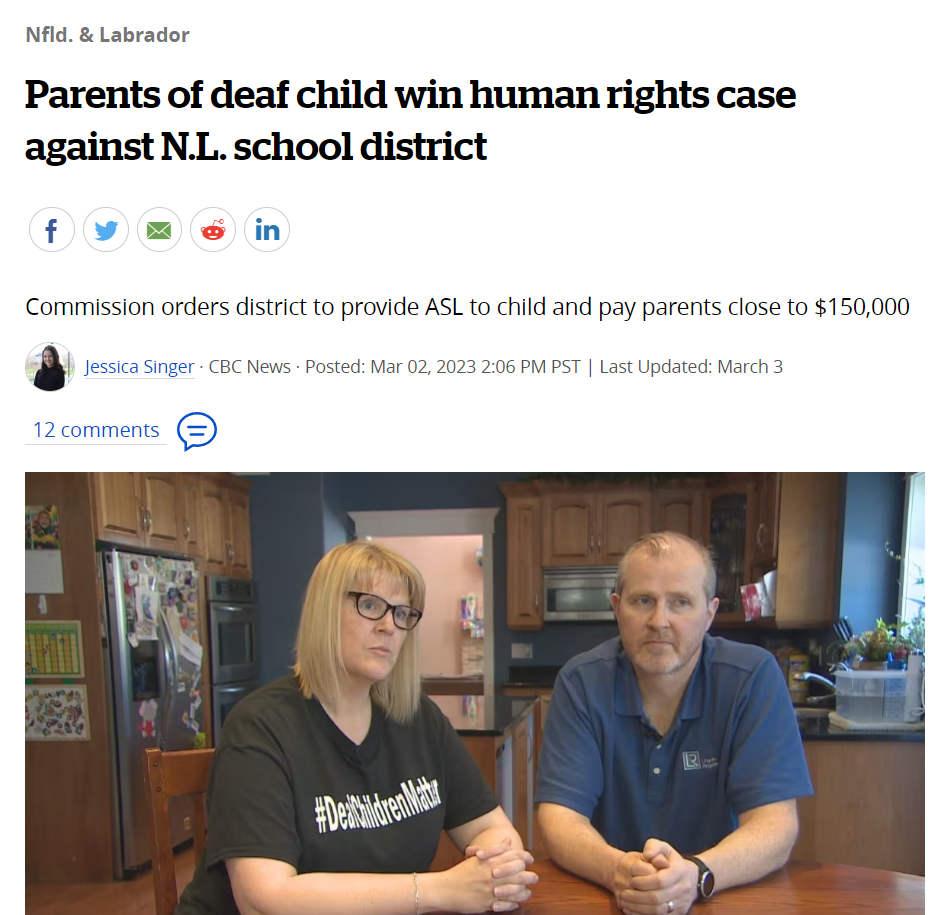
Human Rights – Deaf community – ASL access – Education

Another important win!

Go parents!!

“The decision says Carter is to be supported in the development of ASL, in accessing and being evaluated upon school curriculum via ASL, in communicating his safety and personal needs via ASL, and in ensuring he is not isolated from peers who are able to communicate with him.”

Parents of deaf child win human rights case against N.L. school district

Challenges in BC

CBC – Parents of deaf child, advocates express concern as B.C. college halts only sign language program in province.

ASL interpreter shortage in BC

Why is Documentation so Important?

Because you need to take your allegations out of the realm of conjecture. A case example from the BC Human Rights Tribunal is below.

N obo S v. T and a School District, 2006 BCHRT 546 (CanLII)

[55]           In this case, N states that she is a single parent and has several serious medical conditions, and that, because of this, she has been unfairly treated by the respondents.  As examples of the unfair treatment, she states that the respondents have failed to return phone calls, delayed letters, failed to provide information in a timely manner, and did not properly investigate her concerns relating to her son.  However, she does not include details of any statements or actions on the part of the respondents which would support such a conclusion.  She states only that she “believes” that such a connection exists: that she “believes” that the respondents think they can make her go away by exhausting her; that she “believes” that if she had a partner, her child would have equal treatment; and that she “believes” that she would be treated with more respect if she were married, healthy and had financial resources.   In other words, nothing in the complaint takes the allegations out of the realm of conjecture, as the facts alleged in the complaint do not support a nexus between N’s marital status and disability and her alleged unfair treatment by the respondents. 

[56]           As a result of the above, I dismiss N’s complaint pursuant to s. 27(1)(b) of the Code.

*************

Allegations are what you are claiming to be true. Until they are proven in a hearing and a decision is complete by a tribunal member, until then, they are nothing more than allegations. Be careful about defamation on social media.

So, parents/guardians and loved ones of disabled children in the education system, what does this mean?

It means we need to be documenting EVERYTHING.

Keeping ALL emails, even the good ones.

Logging calls and dates, with who and what was discussed.

Follow up by email on phone calls to outline what was discussed and action steps agreed upon.

Keeping a timeline of events

Taking photos (if your child has been injured)

Take pictures of their school work and/or communication book/agenda

When you child tells you what happened at school, take your own notes and write it down. Email your notes to someone you trust to log the date, time and details. Record your child talking about school.

Email other parents and ask them what they know, and make sure they respond in the email and not the phone. The Human Rights Tribunal can take years. People’s memories will change over time, so it’s really important to get the documented information at that time.

If necessary for your own mental health, take yourself and your child to counselling. They can also write a letter or have their notes involved. If the counsellor is connected to the government services, they won’t be able to testify at a hearing. You need an outside counsellor.)

An added suggestion by Dyslexia BC @DyslexiaBC on Facebook is to bring someone with you to all of your IEP meetings. (That person can take notes and also be a witness.)

You need to be thinking about collecting evidence. Things that can be used as evidence in a hearing are documents, emails, doctors’ letters, counselling letters, counselling invoices, videos, photos, media posts, expert evidence, other parents’ witness statements/emails, voice recordings from meetings, anything that is relevant. Connected. Here is what the Human Rights Tribunal determines to be evidence.

(***NOTE: If you are an employee of the school district, recording laws differ for you. Please consult with a lawyer as case law around this topic fluctuates.)

In the same thread of thought, be careful what you offer up in your emails and conversations to the school district. They are also collecting evidence on you.

I will leave you with this case example below.

A and B obo Infant A v. School District C (No. 5), 2018 BCHRT 25 (CanLII)

A.   The Mother

[40]           Overall, I have found the Mother to be sincere in her testimony. She cares about her Child and became emotional when describing his feelings. However, I do not find her evidence reliable. I find her testimony not to be in “harmony with the preponderance of the probabilities which a practical and informed person would readily recognize as reasonable in that place and in those conditions”. The weight, and thus reliability, of the Mother’s evidence was affected by the fact that her testimony was almost entirely based on hearsay and double hearsay. The Mother was not a witness to most of the interactions she described.

[41]           The Tribunal may admit any evidence that it considers necessary and appropriate, whether or not the evidence is admissible in a court of law: Code, s. 27.2. Silver Campsites Ltd. v. James, 2013 BCCA 292 at para. 39. I considered the Mother’s hearsay testimony to be necessary and appropriate because it directly addressed the critical issues in the complaint and there were no other witnesses available to present it. The Father and Child did not testify on these issues. I assessed the Mother’s hearsay evidence on a point-by-point basis, with the objective of ensuring that I could make necessary findings of fact based on reliable evidence: Radek v. Henderson Development (Canada) and Securiguard Services (No. 3), 2005 BCHRT 302 [Radek]. I have considered the following in determining the weight to give to hearsay evidence:

I have considered in each instance the reliability of the evidence, the necessity for its introduction as hearsay rather than first-hand evidence, the probative value of the evidence, and whether the other parties would be unfairly prejudiced or otherwise disadvantaged through my reliance on it. (para. 54)

[42]           I have assigned relatively little weight to the Mother’s evidence where it conflicted with the first-hand accounts given by the School Counsellor, Principal, Vice Principal, and Teachers H, M, and G. I have found the Mother’s hearsay evidence considerably less reliable than the direct evidence of reliable witnesses, where there is a conflict.

[43]           The Mother acknowledged that she was probably not present for most of the incidents at school that involved her Child. At times, she had a hard time recalling events. For example, the Mother’s testimony on the psychoeducational assessment of her son was wrong by one year. She acknowledged that she was “out a year”. The Mother testified that there is no reason to dispute the emails that were authored by her at the time. The Mother testified “that is what I wrote at that time”.

[44]           During cross-examination, the Mother responded to several questions regarding her testimony about her Child’s version of events by saying that she did not know or was not there. She acknowledged that most of her knowledge of the incidents came through her Child. I find that her son was more likely than not motivated to minimize his involvement in some incidents when reporting them to his Parents, so as to avoid discipline. For example, the Mother described disciplining the Child in relation to an incident where he swore at the Principal. She described their punishment as “Draconian”. (In retrospect, the Mother regretted using that word in her letter). As another example, regarding the November 2016 Incident, the Child only reported to his Parents that he grabbed another student by the collar, whereas I find, as a fact, that the Child choked a student, pushed him over a railing, and spat in his face.

[45]           The Mother’s credibility was also impacted by her acrimonious relationship with most of the Respondent witnesses. I have considered her contemporaneous correspondence in assessing credibility because it speaks to hear capacity to perceive, recollect, and communicate facts objectively. Together with her husband, the Mother repeatedly sent letters and other communications attacking the character of most of the Respondent witnesses. For example, the Parents wrote letters about the Superintendent to the federal government, provincial government, board of education, RCMP, politicians and others. When confronted with this correspondence, the Mother minimized the tenor of her communications and its effect on the Respondent witnesses. The Mother maintained that she and her husband treated staff respectfully.

[46]           The Mother also provided inconsistent testimony. For example, the Mother testified that she did not accuse Teacher G of racism. When confronted during cross-examination, the Mother acknowledged accusing Teacher G of favouring one child over the other, and the other child not necessarily being black. The Mother ultimately acknowledged accusing Teacher G of racism. She explained finding it “very frustrating” when Teacher G prejudged her son and did not follow guidelines.