Systemic Imperfection

Our systems, organizations, politics, cities, committees, boards, non-profit organizations, and every other team effort is not perfect.

There are gaps and administrative unfairness in every single system. If you ever want to understand why our systems are the way they are, read policy books from Deborah Stone (Eg. Policy Paradox” The Art of Political Decision Making) and you’ll understand how strategic this is from a political point of view. The division of resources is certainly not by accident.

Then focus on the next layer: the individuals.

Humans also work on these teams and people make mistakes. We are not a perfect species by any measuring yardstick. We are flawed and we are constantly learning and growing. We have our own trauma, imperfect childhoods, different brain structures and chemical exchanges, different age development stages, different frameworks within how we see the world, and temporary feelings rising and falling in the mix of every single day. Throw in some egos, status, hierarchy, culture, gender expectations, and all social constructions into the constant movement of social interactions. It can be messy. Let’s say that. I am impressed we are able to communicate and work as well as we do.

If we wait for systems and people to be perfect before we enter them or interact with them, we will be dead before that ever happens.

Our external complaint systems are not perfect.

But, they are all we have.

If we stop engaging with them, filing complaints, we are screwed.

External complaint systems are the only source of outside eyes looking into the school system. They are the only hope at accountability and transparency. No one else has access. No other outside organizations can force them to hand over documents or force them testify. If the school districts didn’t know they existed and didn’t think parents would use them, it would be a free for all. They would be untouchable. I have seen what happens when school employees think they are untouchable. It’s bad.

There would be no OIPC for access to information. There would be no Ombudsperson connected to policy and fairness. There would be no regulatory body for teachers and teacher standards to use. We would have no way to enforce human rights and force schools to provide our kids support. No one to force them to have to justify their actions. No one else is watching. But parents are.

Is everyone’s complaint going to be successful? No. It’s not. There is common sense and then there is the limitations of law and process, with cut off dates and made up rules of trying to put a human experience into a box.

But this is how we push the line. This is how we create human rights law (BC HRT), school policy (through settlement agreements), consent resolutions (TRB complaints), orders (OIPC decisions), directions (Ombudsperson decisions and case summaries), that create tools for change. Parents can actually create these tools to pick at the system by their complaint filing and settlements.

Why on earth this immense responsibility for parents to be THE accountability system is BEYOND me.

So until the government system decides an alternative option to help us in this matter, we are on our own. (Some people think school trustees are this alternative option, but some parents feel that school trustees are just upholding the system and colluding with districts.) I don’t even know if school trustees see themselves as an accountability system to the public. Do they? I know some do… but as a whole?

Parents are powerful. The school system doesn’t want you to know this. They want you to be scared. Fearful of making decisions. Fearful of stepping out of line… and dare I say… being a trouble maker???

I don’t suggest to people that they kill a fly with a house and just start filing complaints over every issue. A lot of the time things can be resolved through internal advocacy going all the way up the chain. It’s more collaborative and can be quicker.

BUT.

If you feel like you are a hamster on a wheel and going absolutely no where. If you think they are not motivated to resolve the issues and are just using delay tactics.

Then something to keep in your back pocket….is the external complaint system.

As we navigate external complaint systems or contemplate entering them, a VERY important truth to understand is liability in education.

Every time we file a complaint, we create data. If government systems don’t hear from parents they think everything is hunky-dory. It also forces the schools to be transparent with these external complaint systems and be examined. If they feel like at any moment they are going to have to justify their decisions, they won’t feel like they can get away with stuff in the same way, right from the beginning.

Knowing that they may have to justify their decisions WITH EVIDENCE in front of the tribunal encourages them to want to limit their damage period.

Bellow are some of the decisions that parents have created through filing complaints. I have created a DECISIONS FOR ADVOCACY page under the Education Law tab. We can use these decisions in our advocacy if required. Click the button below.

Thank you parents/caregivers!! Inch by inch, we are making progress. Now we need to take these decisions and use them as our tools. For all of the areas that we still need decisions in, we still have work to do.

Does my Child need to Testify?

The lawyers may tell you they are going to put your child as a witness in the hearing, or hint that your child is going to need to testify, as if this is the natural process. No. There is no guarantee. They may be trying to scare you into a settlement. Just because they may say your child will testify, doesn’t mean it will happen. It doesn’t mean it’s even a smart move on their part.

If your child is old enough and wants to testify, their testimony can benefit your case. The lawyers may say that they are going to take a lengthy amount of time to cross examine your child but then cut it short when they realize your child’s testimony is helping you and not them. Children speaking to their experience can be very moving and compelling. Tribunal members can end up connecting with your child as they testify. Not something the school districts lawyers want to have happen.

Them hinting at you that your child is going to need to testify can be the very thing that ends up shooting themselves in the foot.

How it works for hearings at the BC HRT, they typically plan for 2 witnesses per day. One in the morning, one in the afternoon. So, if you have 10 people on your witness list, including yourself, you will need at least 5 days to present your case. However, your testimony can take as long as you like. You can have written notes in front of you. (Other witnesses cannot. But because you are self-representing you are allowed.) If you need a full day to lay out your experience and show all of the emails and evidence you have, then you can take it. You can have as long as you need. Then the respondents will have their own people and will need to count their additional days. That gives you the idea how long you will need for your hearing. Some witnesses need more or less time, based on their role. Some of your witnesses will overlap. You will be able to ask questions to all of their witnesses just like they will be able to question all of your witnesses and you.

There are two education cases where the students have testified that I have found. The bullying case and the meaningful inquiry case. I have talked to many parents across Canada, and I have NEVER heard of the tribunal forcing any student to testify.

The tribunal makes their decisions in the best interest of the child. If your child wants to testify, it has the potential of being a positive experience for them. Being in a hearing, isn’t horrifying to all people. It’s horrifying to the people who do bad things. I couldn’t wait to testify. It took me all day to testify. It was liberating. I got everything out of me and it was witnessed by someone with authority.

The tribunal is very good at making kids feel comfortable and giving them accommodations, etc. The lawyers would look like complete assholes if they weren’t sensitive to your child during cross examination. (And they don’t want to come off as assholes to the tribunal member.) This isn’t like court cases that you see in the movies where people are dramatic. You will be in your own home, and it will be online. Your child can be in cozy clothes. You can be sitting beside your child the whole time. They can have fidget toys or do anything else that makes them comfortable.

When you are preparing for a hearing, you will have a pre-conference hearing where you will be discussing the witnesses and their relevance. I highly suggest you ask for an agenda for any conference hearings. That way the respondents wont be able to spring topics on you without your knowledge and you can do some research in advance and just be prepared. If you don’t want your child to testify, you can make your case. How do you think testifying could possibly harm them? And can evidence be entered and cross examined in other formats by other means? There are hearings that have taken place and the student didn’t testify, for example in this 2024 decision.

Making the decision for your child to testify is a decision you both are going to need to make. Don’t feel pressure from the lawyers, that your child will be forced to do something they don’t want to do. It’s easy for adults to make assumptions, thinking that your child wont want to participate. But, kids want to help out other kids too. They want to make a difference. They may also be angry or upset about the harm they went through and this can be a healing experience for them too. Something for them to look back on and think….wow, I did that. It can be a bonding experience for you both.

Keep in mind that hearings can take 2-3 years from the time a failed settlement meeting happens. Your child will be older and may view things differently then what they do now. Don’t make things an issue, until they need to be. People may think that having all this time is a bad thing, but it can actually work in your favour. The time gives your child some space and time away from the situation. Also, gives you lots of time to prepare.

HR Decisions in Year 2025

Here is a list of the BC human rights decisions related to students and education (K-12) that were posted publicly in the year of 2025. Only 2 decisions show parents/caregivers who had legal counsel, the rest were self-representing parents. These decisions are important as we learn how the tribunal will make decisions about similar issues in the future. They also can help us to elevate our advocacy and understand our rights. These complaints become part of the wider data collection on these issues that the BC HRT collects.

This does not reflect the total cases that were navigating the HRT, just ones that had public decisions. Cases that settle at mediation meetings, often do not have decisions attached to them as mediation meetings are part of the early stages of the complaint process.

January 24, 2025

The Student (by the parent) v. The School District, 2025 BCHRT 17

[1]               In April 2022, the Parent made a complaint against the School District on the Student’s behalf. The complaint alleges that the School District discriminated against the Student regarding its services based on the Student’s mental disability. Specifically, the complaint alleges that the School District failed to accommodate the Student by not providing him with an Education Assistant in one of his classes.

February 4, 2025

Child L (by Mother L) v. BC Ministry of Education, 2025 BCHRT 27

[1]               This is a decision about whether eligibility criteria for a government grant, set out in a regulation, could be a service customarily available to the public.  

February 5th, 2025

The Parent obo the Student v. Meadowridge School Society and another, 2025 BCHRT 29 

[1]               The Parent is the mother of the Student. The Student attended middle school at Meadowridge School Society [Meadowridge]. The complaint alleges that Rhys Clarke, a teacher at Meadowridge, sexually assaulted the Student during an incident in Mr. Clarke’s class, and Meadowridge failed to address the matter appropriately. The complaint says the Student was in a vulnerable position due, in part, to his Chinese ethnicity. The Tribunal accepted the complaint on the grounds of the Student’s race, ancestry, place of origin, and sex.

March 7th, 2025

P (by KD) v. Board of Education of School District No. 61 (Greater Victoria) and another, 2025 BCHRT 62

[2]               P alleges that during the 2019/2020 school year, the respondents did not provide her an appropriate education by refusing her at-home instruction, one-to-one Educational Assistant [EA] support, and not following her Individual Education Plan [IEP]. P also alleges that the Ministry changed the requirements for IEPs which rendered them ineffective. Finally, P alleges that the School District caused her harm by failing to properly address abuse by another student and took her on an inappropriately long walk despite her scoliosis, which caused her pain and swelling.

April 4th, 2025

Child (by Parents) v. Surrey School District No. 36, 2025 BCHRT 85

  Generally, the complaint alleges that the Respondents failed to provide the Child with meaningful and safe access to education. Particularly, the complaint sets out five allegations that the Respondents:

a.      failed to incorporate medically recommended accommodations into the Child’s Individual Education Plan [IEP] in 2019 [IEP Allegation];

b.      failed to consult the Parents in 2018 in formulating the Child’s IEP [Consultation Allegation];

c.      discontinued specialist support for the Child in 2017 [Specialist Support Allegation];

d.      failed to provide the Child with reasonable accommodation to assist them with managing their disabilities [Accommodation Allegation]; and

e.      disciplined the Child in a way that put them at medical risk as a result of their disabilities [Discipline Allegation].  

May 14th, 2025

Parent obo Student v. BC Ministry of Education and another, 2025 BCHRT 112

[1]  The Student is a young Indigenous child who has diagnoses of various mental disabilities. The Parents allege that the School District and the Ministry of Education [Ministry] discriminated against the Student based on her race and mental disabilities when they would not allow her to attend school full-time or participate in school activities with her peers.

No other decisions were posted after the May decision.

We will see what year 2026 brings us….

Here is a page I have created that collects links and decisions for advocacy.

Keeping Your Child’s Information Private

There is a way to keep your child’s information private as you go through the BC Human Rights Tribunal process (BC HRT). If you want to request that something specific happen you can email your case manager and they may tell you that you need to submit an application or they may be able to just respond to your request in the email. If you do send a request you must cc: the school districts in your email. Not every application that you submit will have a public decision, but it’s possible that a decision regarding your process/request could be posted on their website. These applications are things like amending your complaint, joining complaints if you file a family status complaint connected to yourself, fast-tracking, etc.

You can apply for your case to be anonymized. The the BC HRT will anonymize a minors human rights complaint automatically anyways as it is part of their rules, but it is always good to communicate your wishes.

Page 3 of their RULES book

Complaints about minors

(7) In an application to limit public disclosure of information that would identify a minor, the
tribunal will presume that the minor’s privacy interests outweigh the public interest in access
to the tribunal’s proceedings.

Or if you specifically don’t want the district to be anonymized, it’s good to put this in the application and explain why it is in the public interest for them to be identified. (See below for case example) HINT: The school districts REALLY don’t like to be named. You can use it to you advantage to put pressure on a settlement.

The BC HRT doesn’t really advertise this, but if you don’t want to settle and you want a hearing, you can also apply for a “CLOSED” hearing so that no one from the public attends.

IMPORTANT NOTE: I am going to write a blog on this specific topic, but I just want to drop some info. If the school districts lawyers are trying to scare you by saying they are going to force your child to testify and be a witness at the hearing – NICE TRY. Just because they may want them on the witness list, doesn’t mean they are going to get it. The BC HRT makes all of their decisions in the best interest of the child. But the respondents LOVE to dangle this threat as a way to send your protective parent instincts into overdrive. But, more on this later.

How you do either of these options (anonymization and closed hearing) is by filing out an application.

Go to the FORMS page on the BC HRT website.

You will be filling out a 7.1 GENERAL APPLICATION.

You will be asking to anonymize your child’s name. You don’t need to anonymize the districts name, but they will most likely fight for their name to be anonymized too. Their argument is often that it may expose the identity of the child. You can argue back. There are cases where the identity of the child is anonymized and the district is not. Or if that is not something you wish for, you can agree to anonymize the district as well.

Read everything on the form. There is a process that you have to go through before you submit it. You need to contact the school district lawyers and ask them if they agree. They will have to provide you with “their position” on your application. When you email them, I suggest you give them a deadline. Ask them to respond to you within 5 business days.

This is the same form you can ask for a closed hearing. Just tick off OTHER and write “closed hearing” on the PURPOSE OF APPLICATION page. They give you space to answer their questions, but you can always just write “see attached” and then type up your answers. You can submit up to 10 pages.

REMEMBER: They are always going to analyze you through a cost-risk lens. If you become too expensive, they are going to be more encouraged to settle with you. It costs them big money to respond to applications. So if your mediation meeting fails, become expensive.

Here is a list of some decisions around anonymization.

The Student (by the parent) v. The School District, 2025 BCHRT 17

[8]               Rule 5(7) presumes that a minor’s privacy interests outweigh the public interest in accessing the Tribunal’s proceedings. As such, it is appropriate to limit publication of information that could identify the Student in connection with this complaint.

Mother A obo Child B v. School District C, 2015 BCHRT 64

[21]           Rule 5(7) establishes a presumption respecting minors for good reason. Children are vulnerable, in some cases fragile, and those with disabilities even more so. It is difficult enough growing up in the face of existing peer pressure without having the additional burden of adult-driven issues being superimposed in a public way in their formative years. Moreover, these issues may not be readily understood by other children and used as a tool of ridicule and hurt. While some public exposure is inevitable, broad public exposure through unrestricted publication is neither necessary nor in the child’s best interests. At this stage of the proceedings, I find that the privacy interests of Child B outweigh the interests of the public and Child B’s identity and that of Mother A shall be anonymized.

[27]           I note that Mother A alleges that the complaint and future outcome are specific to the policies and practices of this particular district. Further, she says that understanding which district is involved may be important for the public, or future complainants in School District C or other districts. I find that school districts are large public institutions that touch a broad spectrum of the public. The reasons advanced by Mother A for identifying School District C reflect a legitimacy and the sentiment found in para. 11 of the School District 61 case cited above. In the circumstances as they currently stand, I find that there is nothing that outweighs the public’s interest in knowing the identity of School District C and the open court principle.

[28]           Therefore, I am prepared to grant School District C the requested anonymization for the purposes of only this decision. Unless a further order of the Tribunal is obtained, School District C shall be identified in all subsequent proceedings. If the Respondent School District C finds unique circumstances that weigh in favour of its anonymization, it may reapply for such an order.

Child K (by Ehmke) and another v. Queen of All Saints School and another, 2024 BCHRT 150

In this case the mother and child wanted to be named. The school did not want to be named. Child was anonymized until she is an adult and then can apply to have her name added. School lost their application and the decision was to name them.

(29) I appreciate that naming the School could make it easier for motivated and diligent people to identify the people who were involved in the events of this complaint. In that respect, my order will not perfectly protect the people involved. However, I find that – unlike the individual educators and staff involved – there is a specific public interest in the identity of the School as a publicly funded institution serving the public: A obo B v. School District 61, 2014 BCHRT 105 at para. 11. I am not persuaded that this public interest is outweighed by the potential that some of the educators may then be identified. There have already been a number of complaints and proceedings involving the educators and staff, and Mrs. Ehmke points out that many people within the community already know about the complaint.

(30) I deny the application to limit publication of the name of the School.

To search up more decisions, here are instructions on how to use CanLii.

History of Speaking Up BC

Speaking Up BC is my first website that I started in July 2021. I wrote over 200 blogs from July 2021-Dec 2025. I started it at a time when I wanted to scream at the top of the mountain top. It’s a situation that is hard to explain and one that is quite incredible. There is only one person in my life who knows the whole story. Needless to say, I wont be blabbing about it here. The point is, bad shit was happening, and the fact that the school district was in liability cover up mode, put me into fight mode.

Speaking Up BC was born out of desperation.

My scream from a mountain top is no longer needed. I am moving from being a wild fire triggered by a storm to more of a controlled burn.

Blogs will be continuing. My future blogs on P.A.T.H will mostly be tied to written authority. For example, human rights decisions, teacher regulation branch decisions, Ombudsperson case studies and information, Ministry policy, School districts policy and other documents and accessibility laws. I don’t want to be too prescriptive, but this is what I have planned at this point. Information that can help elevate someone’s advocacy. That is the purpose.

I want to thank everyone who followed my blogs, commented on my blogs and who reached out and had conversations with me. Your support was exactly what I needed, when I needed it, and it truly helped to carry me through. I felt heard. I hope all of my lived experience will continue to help other people. Pain into purpose. My goal has always been to pass along information I wished someone told me.

Now I am shedding the skin that no longer fits.

P.A.T.H is my future. My lighthouse.

Large font. Speaking Up, with a face in the P and lines looking like a voice coming out of the mouth. In the left, smaller font: Speaking Up BC "Education Advocacy. K-12. Disability, BC. Canada."

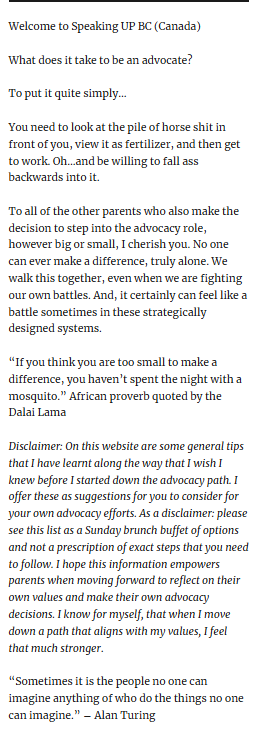
Below is my sidebar on my website. The mosquito quote came from a parent in the BCEdAccess Society Facebook group who passed it along to me. I really appreciated the parents support.

ID Text:

Welcome to Speaking UP BC (Canada)

What does it take to be an advocate?

To put it quite simply…

You need to look at the pile of horse shit in front of you, view it as fertilizer, and then get to work. Oh…and be willing to fall ass backwards into it.

To all of the other parents who also make the decision to step into the advocacy role, however big or small, I cherish you. No one can ever make a difference, truly alone. We walk this together, even when we are fighting our own battles. And, it certainly can feel like a battle sometimes in these strategically designed systems.

“If you think you are too small to make a difference, you haven’t spent the night with a mosquito.” African proverb quoted by the Dalai Lama

Disclaimer: On this website are some general tips that I have learnt along the way that I wish I knew before I started down the advocacy path. I offer these as suggestions for you to consider for your own advocacy efforts. As a disclaimer: please see this list as a Sunday brunch buffet of options and not a prescription of exact steps that you need to follow. I hope this information empowers parents when moving forward to reflect on their own values and make their own advocacy decisions. I know for myself, that when I move down a path that aligns with my values, I feel that much stronger.

“Sometimes it is the people no one can imagine anything of who do the things no one can imagine.” ― Alan Turing

Defamation. You said what?

I had the wonderful opportunity to attend the defamation lunch and learn put on the PLEO society today. https://www.pacificlegaloutreach.com/initiatives

I recommend it to anyone who is interested. I took notes, and these are them below. Some of the terms I jotted down for future reference, and let me acknowledge that I think this workshop could have gone on for a week, there is just so much to discuss and talk about, so these notes are no way an exhaustive list on the topic.

Hopefully you can understand my notes or some of these terms can help you in your own research or lead you to inquire with legal minds about the topic. As someone who blogs, I find this topic fascinating. I can see how this area of law and the discussions around free speech are just going to intensify. Free speech to me is a VERY worthy conversation.

**************************

Defamation is an area of law – protecting someone’s reputation who has had bad things said about them. Hatred, ridicule or contempt.

Said something about you, that it’s published, defamatory – something with a real sting to it.

Liable or slander

Oral or written – can take either form

Even if it’s deleted, still repercussions. It wont matter that it’s been deleted.

Defamation law around hundreds of years old

Someone is presumed to have a good reputation. The damage in defamation go to repair the harm in your reputation. You would need to prove your loses, what you lost due to the defamation statements.

Is a statement defamatory. The judge would decide – What does the statement you made actually mean?

The judge would need to decide if it went beyond insult or criticism.

You can have clear defamatory statements or it can be an innuendo.

Social media has been wonderful for defamation lawyers. Social media posts are not personal conversations, they are to the world. Lawsuits are on the rise.

Sometimes defamation lawsuits draw more attention to the statement and can make things worse.

It is not just a person it can also apply to an organization.

The organization can defame or be defamed. The person who said those things, can also be sued along with the organization.

Defenses?

Truth is a defense – the responsibility would be on the defendant (person who is being sued for defamation) is on them to prove that it is true.

Defense of Fair comment – free speech rights.  – matter of public interest

It can’t be said in a malicious purpose. Eg. You got fired, and so you are making a statement

Two types of privelage. Absolute privelage and qualified privelage (moral obligations, etc) Duty to warn

Duty to warn – is protected.

Qualified privelage is very narrow. Saying you were abused in a tweet, wont cover this.

Right to speak vs. Right to keep a reputation

The law does not protect a sexual assault survivor to speak their truth. The survivor can be sued.

The protection of Public Participation Act 2019. PPA – what kind of speech do we want to protect. The legislation is still new. Not enough case law.

Be ready to back up your statements. If you can support it, than you can make it.  Present it as a fair comment.  You can still be sued, even if you have a defense. They can sue you, just to sue you.

Who is your audience, who are you doing this for? Why are you saying this?

Defamatory is very accusatory, pointing fingers as someone specific

An opinion has be to be one that is reasonably held.

Comments meant to be kept in a friends social media group can be shared

Republication – recent case law

You can be liable for republicizing someone else’s comment. One person posted on Facebook and other people commented. The originally poster was found responsible for other people’s comments. Due to – It was the probable consequences of making such a post in the first place.

You can’t control where your posts go.

Term – Fair dealing

Don’t be fearful about commenting, but do be respectful. If you get it wrong, apologize. A comprehensive apology online.  It stops the damages clock.

If you do defame someone, use your words to deescalate and apologize.

Self-Advocacy and Victim Blaming in Education

Self-Advocacy for Students in School

I have put this blog under my IEP category because this is a topic that parents deal with a lot during their IEP meetings. Teachers expect students to self-advocate during IEP meetings. Which can be really hard for kids, under that kind of pressure. They are also very eager to put self-advocacy into IEPs. I often wonder if they think this takes them off the hook, and they are less responsible for implementation. Even outside of IEP meetings, this topic of self-advocacy comes up a lot. The expectations are sometimes unrealistic, and they are creating new problems.

Self-advocacy isn’t easy, especially in an education setting, which is very authoritative, and kids are expected to fall in line.

Certain elements need to be in place to help nurture self-advocacy.

1. The student on some level needs to be accepting of their disability AND be willing to talk about it.

2. They have to be able to identify when they need help.

3. They need to identify what they need help with and have the language/a way to express it.

4. They need a trusted adult who has proved their willingness to listen to them over time.

5. They need to feel heard.

6. They need to feel that this trusted adult will believe them when they say they need help.

7. This needs to be repeated enough times and be predictable enough for the self-advocate to feel comfortable and safe to advocate for their needs.

School staff may say…..

Well _____________ happened, but if XXXX advocated for himself, this wouldn’t have happened.

The reality of the School Environment

Children, since they enter school, are socialized to believe they MUST follow authority, or something really bad is going to happen. They think they will be disappointing all the adults in their lives, and kids deep down just want to make their loved ones love them.

All they want to do is to make the adults (especially their parents but also their teachers) in their lives happy so that they will feel worthy and good about themselves. We need to look at their situation through the lens of a child.

Learning self-advocacy can take a lifetime. Adults have a hard time advocating. We need to have realistic expectations for our children. Especially when they are navigating an oppressive system, based on hierarchy and control. They live in this environment 5 days a week; we don’t. Many times, kids are expressing themselves and their needs, only to end up not being believed.

Children and teens need a safe adult to go to in schools. Someone that they know will help them when they need it. Finding that person and building that relationship can be key. If it’s not the teacher, could it be the counsellor, the case manager, the head teacher, the VP, or another teacher?

BC Human Rights Tribunal – Advocacy

We have a human rights decision on our side.

It’s easy for schools to make us think our kids share responsibility or are responsible for all of it.

Educators may have to be informed of how self-advocacy expectations have been defined by the BC Human Rights Tribunal. In Student by Parent v. School District BCHRT 237.

Remember the power of the Human Rights Code.

[90]           Generally, it is the obligation of the person seeking accommodation to bring forward the relevant facts: Central Okanagan School District No. 23 v. Renaud1992 CanLII 81 (SCC), [1992] 2 SCR 970. This can be challenging for children, and especially challenging for children with invisible disabilities. I agree with the Parent that children who require accommodation in their school are in a different situation than adults seeking accommodation. Though they have a role to play in the process, that role will be age and ability-specific, and the burden cannot be on a child to identify and bring forward the facts necessary for their accommodation.

We Learn. They Learn.

Advocacy will always be a part of your child’s life. There will never be a time when they will not be advocating for their own needs. Ask anyone with a disability, doesn’t matter their age, and they will still be advocating for their disability-related needs.

You are modelling what advocacy looks like. When they see you advocate, they learn from you how to do it, but they also learn that they are valued enough and that they are worth the effort. A lot of the advocacy that we do they will never know about. But we often reassure them that we are talking with the school and we are advocating for them.

My kids took notice of my efforts more than I realized. It teaches them to its okay to take up space. You are worth it.

I do have to say, it is very cool to watch your children self-advocate as they grow over the years and become adults. They are always watching and learning. Children have their own timing for things. My children grew into this at different times, and they are still growing as young adults. Of course. Self-advocacy skills never stop. They evolve and grow as we grow.

There are advocacy trainings you can take. Inclusion BC, Family Support Institute and the BC PAC have advertised for advocacy development workshops, along with disability specific orgnaizations, at various times of the year.

The name of the game is learning.

We learn. They learn.

Advocacy is Context Specific

As a self-advocate, I would say my advocacy is very context-specific. My approaches vary depending on who I am talking to, in what environment and situation I am in, and even my own capacity at that moment. I don’t have a memorized statement that I just play over on repeat in situations.

The environment of the education system is a very unique environment, and I tell people, this is a different kind of chess game you are in. It requires a specific skill set and a very specific process. Learning the “rules” of the game in education advocacy will help you greatly.

Internal School Advocacy
External Complaint Avenues
5 Rules on How to be Untouchable
Liability in Education
Understanding Systemic Change
The Duty to Accommodate

BC Human Rights Tribunal Complaint Process – The Blame Game

Do not be surprised that if you file a human rights complaint, the response from the lawyers will be blaming your child for not self-advocating, and that is why the school district is not responsible for their accommodations.

It is a common chess move they make. So, just a heads up.

They will also blame you.

However…..”Parental conduct or lack of parental authority cannot be used as a justification for not meeting an exceptional student’s needs

We do have case decisions on our side, too – regarding fierce advocacy or lack of it.

We can have respectful conversations and advocate fiercely at the exact same time. It’s not one or the other. Both parties have the expectation to collaborate in good faith as part of the accommodation process. At the same time, our advocacy conduct cannot be used against our child to deny them an equitable education.

********

L.B. v. Toronto District School Board, 2015 HRTO 1622

[77]        The Interim Decision sets out my reasons for issuing an order with respect to the first two points, as follows:

(a)      School boards have an obligation under the Code to accommodate their students with disabilities to the point of undue hardship, regardless of whether the students are receiving any medical treatment in the community or not;

(b)      School boards cannot order or demand of parents to place their children into residential psychiatric treatment programs and cannot deny or withhold accommodations to the point of undue hardship on the grounds that the student should be in such a program. While I have no evidence to show that this was the case here, that does not alter the principle;

(c)      School boards have an obligation under the Education Act to provide appropriate special education placements, programs and services to their exceptional students. Parental conduct or lack of parental authority cannot be used as a justification for not meeting an exceptional student’s needs; and

(d)      I agree with the decision in R.B. v. Keewatin-Patricia District School Board, (R.B./Keewatin2013 HRTO 1436, an HRTO decision cited by both parties in this case, at para 265, that a parent’s “fierce advocacy” for his or her child must not and cannot prevent a school board from accommodating the child’s needs to the point of undue hardship.

Systemic Impacts of Scarcity in Education

I’d like to bring up the subject of scarcity and the concept of applying the impacts of limited resources in the education system. It could be physical, social, emotional, or mental scarcity.

Limited resources change how people interact and behave at the most primal survival levels. There are already many scholar reports on how scarcity affects decision making and neuropathways.  Scarcity is when there are limited resources and people are not getting what they need.  Animal and human behaviour will change in these environments. When something is scarce, people will put a higher value on it. People will use social capital, aggression, secrecy or whatever strategies they can to obtain those limited resources for their own unfulfilled need. This is evolution and not a personality deficit.

Whittling the education system to bare bones and creating an environment of such limited resources will turn Mary Poppins into Cruella Deville in just a few months. Work environments can become toxic. Communication and information among staff can be used as a source of power.  Confidentiality among staff can be used as a social manipulation tool to build a sense of belonging or exclude.  Subgroups become even more exclusive. People are being set up to fail. It’s not personal. It’s systemic design. Evolutionary instincts will kick in, and not the kind ones. Stress bubbles will burst. People will snap. Children included. Recruiting and retaining quality educators for any length of time, will be challenging. This will have more of an impact on students with disabilities and those in marginalized communities. I repeat. This will have MORE of an impact on students with disabilities and those in marginalized communities.

Understaffing is a form of scarcity. When there aren’t enough people to fill the job duties that are required for functioning, and people need to step over their own job description boundaries to fill in for other people’s work, that has multiple direction points of impact. If it’s chronic, then you’ll see the ripple effects of scarcity.  Work environments will become “unhealthy” and over time people will become very dissatisfied with their work, ultimately pushing them out of the system and creating a deeper wedge in the cycle and it just goes on and on.  Underqualified staff just filling “the body” in the role, is not the solution.  Take a look at the number of job postings for school districts and take a look at the ones that are just continuously on repeat.  The districts are all in the same basket. They are even competing with each other trying to coax staff out of each other cities with advertisements.

School districts are extremely complex human systems. The number of connections and moving parts is overwhelming to me when I try to put this system into a visual representation. It looks like a large spiderweb post wind storm. Not only do I look at all of the individual parts when I look at a system, but it’s the connections and relationships and what is generated out of those connections that also makes my head spin. Now put this very complex system in a situation of scarcity. This has disaster written all over it.

The alarming fact is that the direction the current climate of education in this province is heading, will require people to become even more competitive over the limited resources. Money won’t solve all of society’s problems; however, chronic underfunding is definitely the fuel to this education fire…amongst other things.

Brainstorming exercise:

Let’s list all of the resources that someone seeks in the education system. (I will list a few, but really, I am hoping to encourage the conversation and for people to start making their own lists)

Resources in education. (Staff and students)

  • Social relationships- support, sense of belonging, attention, power, purpose
  • Mental stimulation, communication, information, choice, adequate training, knowledge, context & meaning…blog about context and meaning for students coming in the near future!
  • Physical space, food, water, access to washroom, fresh air, safety…and yes all of this applies to staff too!!
  • Access to tools to complete tasks/goals with success
  • Time to process, time to complete work, alone time, enough sleep – proper work hours (homework or class planning)
  • Currency – (staff) to access resources in their personal life and avoid scarcity

Now take all of those resources to function. Put someone in the situation of abundance. All the time in the world, lots of attention, all the communication and information they need to understand their environment. Now take the minimal of what you need and cut it in half.  Survival mode kicks in. You will have very different people on your hands.

If people have options, they will leave the system. We all have our breaking point.

Who is controlling the resources to this system?

It’s not the school districts. They may be managing…I mean struggling, with the system, but they aren’t the Wizard of Oz at the end of the road. The Ministry of Oz is hiding amongst ambiguous unanswered questions in their huge castle.

Provincial systemic issues, are going to need a provincial intervention approach, and will require a provincial response.  Let’s start with some resources, shall we? Adequate funding please.

What is the Ask? Email Writing for School Advocacy.

Before I jump into the theme of this blog, I do want to mention that if you email someone in the district (head office) and you don’t cc: the principal, the email you send to the district will be sent to the principal of your kids’ school first. They will check in with them before they touch base with you. You might as well cc: the principal in the email anyway, and appear transparent and working in good faith.

I can’t tell you how important it is to get really good at emails. Email is a tool in your toolbox. Knowing how to write emails and who to send them to and include will help you. For example, to decrease the chance of someone ignoring you, include more than one person in an email. For more info about emails, read Inclusion BC’s manual and Family Support Institute’s email guide.

Always remember that any email you send can be sent to anyone in the district, can be sent to their lawyers, and could end up in a hearing. Emails are not private conversations.

Ok, now back to asking.

A very common thing for people to do when advocating is that they are not clear with their ask. They spill out an emotional story and are often all over the map. (No judgement. I have sent these emails too.) Then they end their email. The reader is left wondering what you are actually asking for. Some people don’t know what they want. All is very common.

What exactly do you want?

When do you want it?

How do you want this to happen?

Putting a clear ask in an email is very important and often overlooked unless you intentionally focus on it.

At the end of every email you send, if you want the school to take action on something, you are going to need a clearly defined request.

I even suggest you explicitly state things that are time sensitive. “This is time sensitive”. There are things that you can be explicitly clear about. The clearer you are, the better, for all involved. Putting a date of when you would like to hear from them can also be helpful. “Could you please respond to me by Friday, September 26th?”

If they are ignoring you, I suggest this page. How to Deal with Schools Giving You the Silent Treatment.

In some emails, it’s unclear if you are even expecting a response, or if you’re venting at the person or telling them off (which I don’t suggest). If you want them to respond to you, you can say something like, “I look forward to your response”, or I would greatly appreciate a response within the next 3 days.

My suggestions for an email format is:

  1. Start off with a connecting statement. (I hope you are well/thank you for your previous email; I appreciate your follow-up/etc)
  2. State the facts of what has happened. (facts only)
  3. State your concerns (thoughts, feelings, opinions)
  4. State your ask (what do you want to have happen)
  5. End with an appreciative closing statement (I look forward to meeting with you and discussing this further/thank you for your support/etc)

    .

If your child is telling you things, you need to make that clear. Johnny told me…… Do not assume that you have the whole story. Quite often, you will not. Don’t automatically accuse the teacher of what your child has told you. You will need to do some investigating and be a detective first. So, your first approach is to be curious and inquire, seeking more information. You don’t want them to be defensive and shut down on you. A carefully crafted email could get you the information you are looking for before you make decisions on how you want to resolve the situation.

Never make assumptions.

A blog I highly recommend you read and consider when engaging with education staff is the blog 5 Rules on how to be Untouchable

Here is my blog on Email: Q & A

A mug I saw on social media that makes me laugh. “Dance like no one is watching. Email like it will be read out at a tribunal.”

What Does Ableism Look Like in Schools? It Looks Like This!

When a teacher daily allows a student with a learning disability to fail their class, but does not even lift a finger to inform the case manager or parent, that is ableism and its discrimination. Disabled children failing, falling behind and being excluded without accommodations have become the normality of the education system. It’s so common, it is woven into the fabrics of the system.

They just invisibly slip through the cracks, while a detailed IEP sits in a student database system collecting digital dust.

The fact that the Ministry of Education intentionally doesn’t even track information regarding the human rights violations that are occurring across the province is an example of ableism. Disability issues don’t affect them, so they have the privilege to ignore it. Want to know how to systemically keep a marginalized group of people oppressed? Keep them off your radar to begin with. OH…and by the way…the group the people the Ministry of Education are intentionally oppressing, are disabled CHILDREN and their family unit.

What is even more profound is that these teachers who are discriminating are caring people. They love teaching and are inspired by the creations of their students. We think ableist teachers are lurking somewhere in the dark with DON’T CARE tattooed on them, when in fact that simply isn’t the case. When children are ignored and neglected in the education system by good teachers, that is obvious discrimination at its finest. The “other” students get their gifts, and the disabled students get left alone, left behind, and just….left.  There are lovely people out there in the world completely unaware of their own biases and the normality of disabled children failing, just blends in with the wall paper.  It’s not even a big thing. It’s just something that happens. Shrug.

This is very common in the education system, and the ableism these kids experience is then internalized, becomes part of their self-concept, self-esteem and identity. Want to know why kids turn to drugs and crime? Failure in the education system has been proven to be foundational in many of the peer reviewed journal articles. IT’s not that we do not know. It’s not that more studies are need to be done. We have all the information. Government is just biased, ableist and discriminatory and this shows in their government run and funded education system. It oozes out of the pores of all 60 school districts. It’s not obvious to the people who are not impacted by it. You need to look at the system and not just focus on what is there, but what is missing. Who is missing?

We need to flip this education system upside down and inside out. The future of their lives and our society depends on it.

Ministry of Education- It is time for anti-ableism leadership from your government.

Are we on your radar? Or will we continually be swept under the rug?