Teachers Regulation Branch (TRB) Decision

Here is an important TRB decision about a teacher who was too rigid and the impacts of their rigidity impacting students differently. More so for Indigenous students and neurodivergent students.

“Polishak did not generally adjust his manner of teaching, classroom expectations or assignments to support students’ individual learning needs. A parent of student (“Student A”) asked for Student A to use headphones in class while working on assignments to assist with focus, which is a helpful strategy for students with ADHD. Polishak did not allow Student A to use headphones and did not allow it for some time after the School principal advised him to do so.”

ALSO:

“In the 2023-2024 school year, Polishak generally used rigid classroom rules, which he rarely modified to support the individual needs of all learners in his classes. These rules negatively impacted some students more than others. Over one-third of the students in the School were Indigenous and many of them bussed to and from the School. Polishak’s rules included:

a. Students were required to value all of the class time by not being late. When a student had a history of lateness, Polishak sometimes refused to let the student enter the classroom. Polishak required late students to wait in the hallway for up to 15 minutes, which resulted in students missing more learning time and sometimes falling behind on in-class assignments.

b. Polishak required students to complete all assignments. He did not usually modify or adjust assignments to meet a student’s individual needs. Polishak imposed a “homework detention” on students who had not completed assignments, by which the assignment had to be completed under his supervision before or after school, at lunch or during the flex block.”

There is more to this decision.

Here is the decision in full:

Jonathon Tyler Polishak

Getting Documents!

Alright, we have seen how the Ministry can “inadvertently” not disclose documents. (wink wink). Yeah right!

Lawyers not disclosing documents and withholding evidence they shouldn’t be, isn’t a new issue AT ALL! They can pull some sneaky shit. This is one area they like to take advantage of, and sometimes it takes a legal process to pry out the evidence. People who engage in litigation for their employment, deal with this issue more than they should. It’s bad, and I don’t want to normalize it. I am just not shocked at all that they had disclosure issues.

Improper conduct complaints have been filed at the BC Human Rights Tribunal (BC HRT) around this issue and I have read decisions when respondents have had to pay costs ($$$) if it discovered during the process of a hearing that documents were not disclosed.

Parents can file a Freedom of Information (FOI) request for documents to their school district requesting information about their child and personal information about themselves as well. If you want an example of how to write this, and have some added information about this process that is good to know, I have a Freedom of Information page. If you look on your district’s website they should have information about it. Know that they will view this as an adversarial move. Just be aware. They don’t like them.

I can tell you right now, you are NOT going to get all the evidence you want through your FOI request alone. It is going to take some time and detective work.

Because schools have risk-management and liability as the captain of their ship for decision making, they are NOT going to just roll over and give you all the evidence you need to be successful against them in a legal process.

You still may get some pretty interesting things in your FOI response package. I have. Some of it has been VERY interesting. They accidently sent copies of emails they sent to their lawyers during one FOI request. Another FOI request gave me an email from the external investigator trying to soothe the staff, saying she had experience with difficult parents. That gave me a good chuckle. Never thought I would be labelled a difficult parent for not wanting innocent children to be hurt. But the GOLD NUGGET evidence I had to get was through the Application process during my human rights complaint.

Let me tell you all about this little adventure.

I submitted an FOI request. What I got back was a lot of documents. They printed them off and shipped them to my house. Around 500 pages. Interesting. Other packages came digitally, so I don’t know why I got paper copies of this one. Other parents have received paper packages sent to their house as well.

I was chunking up the topics and going through everything. Then I put everything back into order. It was then that I realized pages were missing. It would go from 168 and the next page would be 172. ummm. hello. what?

Then there was this one document in particular, a very important email that I was never provided, that was sent to the staff in the school about my child. It was not in the FOI package. BUT. I had an email from the staff member who told me they would be sending this email out, so I knew it had to exist.

When you file an Office of Information Privacy Commissioner (OIPC) complaint, you have to go back to the school district and say, hey, I notice that __________ is missing. Can you recheck your files please and send it to me. When they don’t. Then you can file a complaint. Which I did. By the way, you can file a compliant too if you find the redactions questionable. AND they do push on that. So if they think they can hide stuff and get away with it, they absolutely will. You need be a detective. You need to read everything and look and see if people are talking about meetings, or communicating with people, or sending emails about things that you don’t have notes or copies of. (Also note, the school district will take all the extensions they are allowed to take. They will respond to you late, and make you come to them in hopes you lose it. To exhaust you.)

Now, a complaint with OIPC about missing documents mean you are filing due to an “inadequate search”. Basically, OIPC says, school district can you look more, and the school says, okay fine we did and we couldn’t find it. Then OIPC will come back to you say, they looked and couldn’t find it. OIPC is satisfied. File closed. …..eek…okay then…..

OIPC doesn’t have much teeth with this topic. But I still recommend parents file an OIPC complaint. More work for the district and it forces them to lie to the OIPC. If you ever find out that they weren’t honest, you can go back to the OIPC and re-open the file. If OIPC concludes they were up to no good, you could take that and give it to the Board of Education. Say, hey, your school district is not ethical.

So my file was closed. I did not give up.

I waited….

We reached document disclosure time. The respondents did not provide the email in their disclosure package. I asked them for it. They said they didn’t have it. I told them I was filing an application anyways, which I did. Years of being told they didn’t have it. I never believed them. The form to file an application for documents is Form 7.1 GA 9- tick off the box to order the other party to disclose documents.

Sent in the application and lo and behold. Guess what. (insert eye roll). Along comes the email saying that they found it in someone’s email inbox. BULLSHIT! They couldn’t find that before???? This was an email that was sent YEARS ago. The district’s inbox doesn’t hold that much. I know that because I worked for them. They would have had to dig this up in their delete folder along with everything else they dug up. LIARS. If this email wasn’t disclosed they would have had a very strong defense that my child’s teacher wasn’t aware of their disability which would have been a game changer in their favour. So, this was a huge win for me.

Now about document disclosure in general. Which occurs after an unresolved mediation meeting. If they want to settle with you, you wont reach this stage. The document disclosure the lawyers gave me was friggen ridiculous. They basically try to overwhelm you with many pages of absolutely nothing. I wrote a report on a related issue I was advocating with a group of parents on, and it was 50 pages. They gave me that same report 12 times just connected to different people’s email as an attachment to make their disclosure bulk up. 600 pages of my own writing. Geez, thanks! Their document disclosure wasn’t anything I already had, and they resent me stuff I sent them back to me.

I had to FIGHT for every little piece of evidence that I got. And then when I was getting stuff through the MULITPLE applications I was sending. They were redacting stuff. I didn’t even know if they were allowed to do that or not. So I asked my case manager. They said I could ask to have it removed. So I did. And they were still sending me stuff not fully unredacted. So I had to ask again. I am telling you. Prying evidence out of them will take nothing but sheer persistence. But if they are fighting this hard to keep it, you know it is GOLD. And oh boy!!! Was it ever. Like fall of your chair kind of evidence. I can’t believe staff were putting this stuff in writing. I can tell you the district has since tightened up what they document. For parents who are now struggling with the district not willing to document anything. Sorry folks. I think I had something to do with that. The district learned their lesson.

Another thing I want to tell you about documents. If they keep resending you document packages and shuffling things around with new dates and new subject headings. You can file an improper conduct for that. Keep a list of all of the shady stuff they are doing to try and exhaust you. Wait until you have a bunch of good stuff and then nail them. The form to write an Improper Conduct application is the same as the 7.1 form just tick off the box GA12 – Order another party to pay costs because of their improper conduct.

Lawyers should not be taking advantage of the fact that you are self-representing. But some lawyers will do that. You can also file a complaint against them personally with the Law Society. Here is the Code of Conduct for Lawyers in BC.

Ok, so long story short.

  1. Be pleasantly persistent. Be a cheetah. It is going to take time. Cheetah’s are very very patient. File the complaints you need to file. If you lose your shit in the meantime, they will use it against you and you will go absolutely no where. They can file an improper conduct complaint on you too. Which they would love to do to get the case dismissed. You need to be extremely civil. Here are 5 rules on how to be untouchable. You want them to be the ones you can nail in an improper conduct complaint, if necessary.
    .
  2. They will not give you everything you need. You are going to need to be a detective. Wait for the right time. File your complaints. You are going to need to hunt for documents very strategically. Unfortunately if often takes the teeth of a legal process to force this evidence out of them.
    .
  3. If they start playing funky-monkey games with you. Don’t lose your shit. You have options to complain that they are not going to like.
    .

And that my friends is the tale of getting documents.

Hopefully you can use this information to help you all in your search.

Stay strong out there!

Newsletter – February 1st, 2026

NEW BLOG: February 1st – EMAILS Question & Answer

News from the BC Human Rights Tribunal: User Feedback on Mediations

Noteworthy Facebook Posts: Here are a couple of Facebook posts that are noteworthy enough to send to your inbox on a Sunday…at least I think.

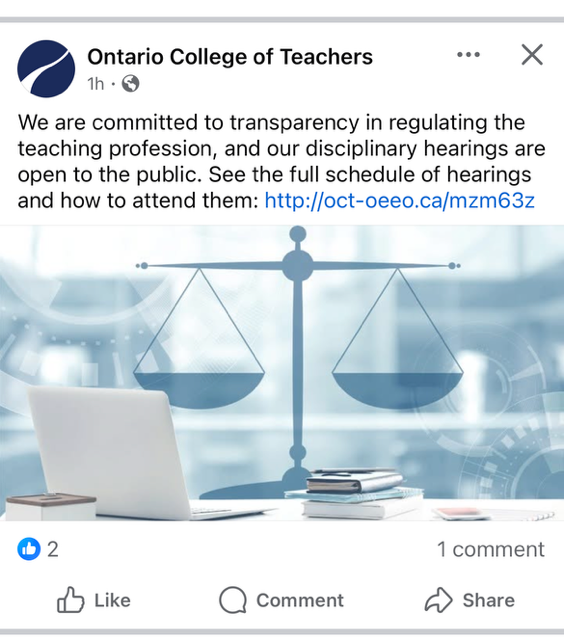
Ontario College of Teachers

This is a Facebook post from the Ontario College of Teachers that was just on my feed this morning.

(ID: Image of Balancing scales, laptop, books with text: “We are committed to transparency in regulating the teaching profession, and our disciplinary hearings are open to the public. See the full schedule of hearings and how to attend them: http://oct-oeeo.ca/mzm63z)

We used to have a teachers’ college in BC, but it was disolved to its toxicity, and the Ministry of Education absorbed it. The Professional Conduct Unit (Teacher’s Regulation Branch-TRB) is a department of the Ministry of Education and Child Care. For people who like to deep dive on the internet on topics, there was a report about it called “A College Divided: Report of the Fact Finder on the BC College of Teachers,” and there were many newspaper articles about how dysfunctional it was and was described as “toxic”.

There is a massive difference between the Ontario Teachers’ College and here in BC. One of the differences I have been dealing with through the OIPC. But that is a story for another day.

The Ontario Teachers’ College is focused on public trust and transparency. I have written previous blogs on my Speaking Up BC website about TRB and how much I do not like how they operate. (I will be combining them and writing a more organized blog in the future.) The websites are an example of how different they are. Ours is a maze, and theirs is clearer important information for parents.

They also give parents a copy of what teachers submit in their defence. Our TRB does not, and the only way to get access to them, so far, is through an application through the BC Human Rights Tribunal. You will only be able to get to apply for those if you have a failed settlement meeting and are going through document disclosure.

Just want to flag this for everyone. Our current regulatory system could be doing a much better job, better aligned with the public and not protecting teachers. They need to prioritize the needs of children, not adults who need professional development help.

I will link some info in the comments.

Here is the report: A College Divided: Report of the Fact Finder on the BC College of Teachers https://www2.gov.bc.ca/assets/gov/education/administration/kindergarten-to-grade-12/reports-and-publications/2010_factfinder_report_bcct.pdf

Ontario College of Teachers website. They even have tab titled “public protection” https://www.oct.ca/en-ca

Our horrible TRB website https://www2.gov.bc.ca/gov/content/governments/organizational-structure/ministries-organizations/boards-commissions-tribunals/commissioner-for-teacher-regulation

Here are some media articles about it.

The Tyee – Behind the Fight Over Who Runs BC’s College of Teachers

City News – BC Teachers College is Dysfunctional

CBC – Report Slams Teachers College

Hello Everyone,

My P.A.T.H website has been a way to share and collect information for parents/caregivers who are advocating for their neurodivergent/disabled children in the K-12 education system.

It has been a labour of love, healing, and peace for me. I am now quite pleased with the collection of information I am able to provide. Finally, I sleep very well at night.

Knowledge is power. Understanding the rules of the system is vital. It is a tough maze we walk through.

I am hoping people will share this information. I would love to see this rights-based information on other websites. It needs wings, and it needs to fly. So, parents, organizations, and other school advocates, I am pleading with you to add information about human rights, external complaint systems, education cases, and advocacy decisions to your own websites. You don’t need to link this back to me. Just take it and run with it. The priority should always be to provide information to support families so that they can support their kids. I don’t view the information on my website as belonging to me. I don’t own it. Take it, spread it and do more with it.

Some people don’t want to engage with lawyers or senior administrators. They feel it’s overwhelming and outside of their capacity. “It’s too much.” If you are advocating, you are engaging with their risk management process whether you want to be or not. I can assure you, the school will certainly be. I say this with my love in my heart, you either learn this stuff at a rate you can handle and try your best, or find an island to live on and unplug from society. There is no escape. They aren’t asking for your consent to participate in their risk management strategies. Because even if the school views you as a “nice, agreeable person” and of no concern, you are still being evaluated. You are just considered low risk. When resources are this scarce, the squeaky wheel gets the grease. I can assure you – you have more in you than you even know.

Rights-based advocacy is our hope and pathway to equity. ❤️

Complaints are the Ultimate Protest

External complaint bodies are the only ones with investigative powers to look inside what is happening in the world of education.

Parents are the ones who have the ability to file a compliant and invite other professionals (mostly legal) into the districts to take a little lookie-loo.

These organizations have legislation behind them that gives them the power to force the school to hand over unredacted documents for their examination. Compel witnesses to be questioned. For teacher’s to explain themselves against teachers standards. Decisions get made – posted publicly. Journalists have access to these decisions and they write articles on them. They spread. Sometimes nationally.

This type of protest…compliant filing…is permanent. If nothing else, it creates data collected by the organizations. It informs them of what the issues are. We are seen. We aren’t invisible.

Ombudsperson BC – makes systemic strategic decisions based on the complaints being filed. The complaints lead the way. For example: The school exclusion investigation currently taking place.

Teachers Regulation Branch (Professional Conduct Unit) – department of the Ministry of Education can remove someone’s teacher’s license and ban them from the profession, suspend them, or send them for professional development. The professional development piece can even happen if the decision doesn’t get posted. The complaint stays in their file.

OIPC – Protectors of privacy but also allowing us to access documents they would never hand over.

BC Human Rights Tribunal – creates case law that sets the foundation and the framework with how the school needs to function, or face the consequences. Human rights complaints can be like a car crash for a school district. Depends on the type of complaint, the complexity, the fault of staff, and how far you take them through the process. They can incur direct and indirect costs. Legal fees are expensive. Their insurance will go up. There may be casualties (staff may leave or be forced to leave). There may be injuries (staff may experience health, emotional, mental, or financial harm). The district needs to deal with the aftermath.

When I started filing complaints, I found it to be so incredibly stressful, but at the same time found it oddly comforting. It gave me hope. It saved my sanity. Took the edge off. Gave me something to focus on. Somebody else needed to know what I knew.

It came down to this:

I will never prioritize the needs of adults with resources over a trapped child experiencing harm who has no escape, and can’t do anything but endure.

Not filing a complaint on an adult who is a paid professional because you don’t want to be the one to make them feel uncomfortable feelings, meanwhile your child is experiencing hell, doesn’t make sense to me. Sure, it doesn’t feel great, but I am not keeping silent and upholding up this system so you can feel comforted in your safe predictable environment. You want to shove this under the rug without getting a scratch. Ummm no!

This is the protest. When we give them all the chances in the world to make this right and they still don’t…this is the only power we have to try and fix things.

What really gets me is that if they feel like they can get away this shit, they will keep on doing it. That. I can’t handle.

Schools can be a little too good at prioritizing their own liability needs.

So when should we file?

I absolutely do suggest you give the school a chance to resolve this with you before you start filing complaints. It truly will be better for you and your child to get a quick resolution. Climb the ladder and go above the principal. Contact the district administrators. These complaints systems are SLOW.

However….some of things that people tell me… and what I know as well…. I mean… come on districts…. are you seriously not expecting a reaction? We aren’t looking for the power struggle. We aren’t.

I have never met a group of people so hell bent on shooting themselves in the foot, than I have with school administrators. Well.. some of them.

The people who are really good at their jobs are people who are focused on communicating and solutions. These are the people we love. These are the people the next generation needs.

The next generation also need advocates. Willing to protest.

From a systemic perspective. We need the risk takers. The wild ones ready to plow new paths that seem completely illogical. We need the quieter, relationship focused advocates building inch by inch. We need the backstage advocates with the networks and unknown conversations. Swaying power every so secretly.

These external complaint systems are far from perfect. They are also all we have. If we all just stopped engaging with them until they were perfect… we would be in serious trouble. The education system would truly see us all as door mats. Buzzy mosquitoes to flick off.

If you do choose to file a complaint. Please do your research. Each is a silo. Different legislation. Different outcome options and different amounts of power. You have options.

If filing a complaint is something you don’t want to do. You still have options. It is not all or nothing. Advocacy still continues. Persistently. Consistently.

Trust in your ability to know yourself. You will find the path that you want to take. The one that matches your advocacy style. All is good. Everyone is needed and all of the different styles. We balance each other out. This is a marathon. It’s a team sport. We train individually, but we run together.

Peace.

Parents take Ministry of Education to Court – Win for Equitable Education

This case is a fascinating read.

Parents took the Ministry of Education in Alberta to court.

Kerber v Alberta, 2025 ABKB 98 

https://www.ctvnews.ca/edmonton/article/parents-take-province-to-court-over-order-keeping-some-kids-out-of-classrooms-during-strike

There are two parts that stick out to me, that I think you will all find interesting.

The Ministry trying to disconnect from their own orders they create and the labour shortage paragraph.

Let me hook you in with this line:

[152]      The Charter guarantees equal access to education for all students; the corollary effect is that that the equitable principle must be applied in times of labour or resource shortages.  Here, what is apparent is that there was no consideration of how the reduced resources could be redistributed among all students.  It was assumed that minimal disruption to the system would result by targeting only a sub-set of students – those who use an EA. However, this approach failed to consider that non-disabled students might suffer the least amount of harm since they do not have the same disadvantages as the students with disabilities and could adapt to an at-home learning program more easily, i.e., some non-disabled students switch to at-home learning to free up more resources for complex-needs students, or some of them, to attend school in-person even with the EAs presently unavailable.

EQUITABLE PRINCIPLES MUST BE APPLIED IN TIMES OF LABOUR OR RESOURCE SHORTAGES. Woohoo! Thank you!

This case is in relation to a strike.

[1]               Approximately 3,700 complex-needs students have been advised by their schools that they must continue their education programs on an at-home or a rotating in-school basis because of the strike involving support workers at Edmonton Public Schools. This situation has persisted for over five weeks. 

Why?

Because…..

[7]               On January 9, 2025, CUPE 3550 issued a notice that it would be going on strike as of January 13, 2025. A range of support staff, including administrative assistants, clerks, educational assistants, food preparers, interpreters, library technicians, licensed practical nurses, speech language pathology assistants, and technicians have been on strike since that date.

So the Ministry of Education in Alberta did this.

[9]               On January 12, 2025, the day prior to the strike, the Minister of Education, Demetrios Nicolaides, signed Ministerial Order #002/2025. The Ministerial Order states:

I, Demetrios Nicolaides, Minister of Education, pursuant to section 4 of the In-person Learning Regulationexempt The Board of Trustees of Edmonton School Division from the application of section 2 of the regulation to provide an in-person learning option, at the schools under its authority, to students who require an educational assistant due to complex needs where the continued attendance of those students at in-person learning may risk the health and safety of the student or other students or staff, subject to the terms and conditions in the attached Appendix.

Which means kids with complex needs are being excluded from in-person learning.

So 4 parents took the Ministry of Education to court.

[4]               The Applicants, who are four complex-needs students affected by the Ministerial Order, seek an interlocutory injunction suspending the operation of the Ministerial Order or, alternatively, an exemption to the Ministerial Order, until the summary judgment or trial can be heard and determined on the Charter issue.

The Ministry of Education tried to pass the issue and blame the school district. Saying the school district didn’t have to follow the order they were just given permission to do so. (OMG! Insert huge eye roll. I actually laughed out loud when I read this!)

[26]           Alberta argues that the Ministerial Order does not require the ESD to stop providing in-person learning to particular students; it merely permits the ESD to make decisions about at-home learning considering the safety of all students and staff within its schools in light of the strike action. 

The court saw through that BS.

[40]           While Alberta is correct that the Ministerial Order does not require any student to learn at-home, the Ministerial Order is the permissive enabling enactment that grants the ESD the authority to make decisions about which students must switch to full or partial at-home learning. Alberta is the correct party to name in this application.

So Ministries of Education across Canada, if you write discriminatory policies don’t blame the school districts for acting on them.

For those who like legal mumbo-jumbo, there are various forms of legal analysis in this decision.

The conclusion was that the parents won the injunction they were seeking.

And as mentioned before I really like this paragraph

[152]      The Charter guarantees equal access to education for all students; the corollary effect is that that the equitable principle must be applied in times of labour or resource shortages.  Here, what is apparent is that there was no consideration of how the reduced resources could be redistributed among all students.  It was assumed that minimal disruption to the system would result by targeting only a sub-set of students – those who use an EA. However, this approach failed to consider that non-disabled students might suffer the least amount of harm since they do not have the same disadvantages as the students with disabilities and could adapt to an at-home learning program more easily, i.e., some non-disabled students switch to at-home learning to free up more resources for complex-needs students, or some of them, to attend school in-person even with the EAs presently unavailable.

And yes I too would like to thank these parents for bringing forward education cases under legal analysis.

[161]      I wish to thank counsel for their excellent submissions.

[162]      I also wish to extend my gratitude to the parties and the families for their participation in this important issue.

If you want to skip the legal analysis and just go to the conclusion at the bottom, it starts on paragraph 153. Here is some of it.

[157]      The nature of the harm that the Applicants would suffer is significant.

[158]      The nature of the legislation under attack is the provision of education – a fundamental service owed to all young people.

[159]      The public interest lies in ensuring equitable treatment of all students during a labour shortage and a fair redistribution of available resources that does not discriminate based on a disability.