
You have a situation at your child’s school that you realize, with all your best efforts, is not being resolved internally. You have gone all the way up the chain of command, and you are just a hamster on a wheel going no where. You need help. It would help if you had an external organization to intervene. Who do you go to?
Not necessarily an easy question.
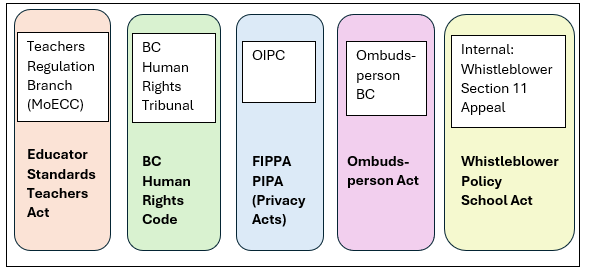
Each option is connected to their own separate legislation. They are each a silo and operate independently. They are not connected. Knowing which avenue is most appropriate can save you months and even years of potential disappointment or wasted time.
Just because you are filing a complaint, doesn’t mean it will be accepted or that the external organizations are going to do any action. All of them have various levels of reviewing your complaint and letting you know if they are going to investigate it and/or accept it into its process. Each external complaint organization has their own mandate and your complaint will be analyzed to see if it fits.
These external complaints will cover issues like:
- IEPs not being followed, Safety plans not being followed. (Yes – you can absolutely do something about this, you don’t need to accept it.)
- Exclusion
- Teachers saying harsh horrible things to your child
- Unfair discipline related to their disability
- Being denied support/accommodations (You don’t need a designation or IEP to be legally entitled to accommodations in school)
- The school ignoring you
- The school not following policy
- AND MORE
| Organization | Retaliation Protection | When will the school know if I filed a complaint? | Can I withdraw? |
| Professional Conduct Unit – Teacher’s regulation branch (TRB) | Kind of – Nothing in the legislation. They tell you, just to file another complaint on the retaliation. | About 5-10 days after you file the complaint. The teacher will get a copy of everything you submit. | No. Once you file it, you can’t take it back. |
| BC Human Rights Tribunal (BC HRT) | Yes – They have a separate complaint form just for retaliation | They will not know unless it is has been accepted. Around 18 months after you submit it. Unless you tell them as part of your advocacy strategy. | Yes. You just fill out a form and send it in. They will sign it and send it back to you as confirmation very quickly. |
| Office of the Information and Privacy Commissioner (OIPC) | (I have never heard of this being needed) | If they accept your complaint and process it. About 6+ weeks after you file your complaint. | Yes. You can even ask to re-open a closed file if you have new information. |
| Ombudsperson BC | Yes – It’s in their legislation | Only if they accept your complaint for investigation. About 3+ months after you file your complaint. | Yes. You just email the investigator working on your case. |
Here are your options and the legislation they are attached to. Here are a list of decisions parents have already created through their own complaint filing. These decisions tell us our rights and the schools responsibilities.
The TRB is connected to the Teachers Act. If the teacher in your child’s class has violated the standards for educators you can file a complaint. The Commissioner will determine if their behaviour was enough of a marked departure to lead to a consent resolution. The TRB will not consider human rights discrimination in the way that the HRT will. They are connecting the teacher to the Teachers Act and their professional standards, not determining if their behaviour was discrimination or related to the Human Rights Code.
Before you file a TRB complaint, please read my full page on all sorts of important information about what you need to know when filing a complaint.
There is no retaliation protection built in to the legislation; they advise you to file another complaint for the retaliation.
When you file the complaint, the teacher will be notified 5-10 days after. The district will not automatically know unless the teacher or you tell them. Here is what the BCTF tells teachers who are under investigation.
They will get access to ALL of your documents. You will get access to ZERO of their documents. You will be invited to participate in an interview if you wish. It’s optional. I have found them to be helpful in allowing them to ask me questions so I can fill in the holes of any of the information they aren’t sure about.
If you change your mind and you want to withdraw your compliant, you can’t. Once you file it is on a non-stop train. All other complaint systems you can withdraw, but not this one.
The HRT deals with the Human Rights Code. It is an administrative tribunal and this area connected with disability in education is most likely going to be tied to Section 8: Duty to Accommodate. This is a legal process connected to the Human Rights code. That’s it. They will not be applying school policy to their decision-making, they may use other legislation but the discrimination part will be just The Code. Understanding the components of the duty to accommodate is key.
There is case law around the schools responsibility to prevent continued bullying, and not having barriers that would prevent a disabled child from accessing their education connected to a duty to accommodate. This includes a duty to inquire, a duty to consult, and a duty to co-operate in good faith. Parents then have a duty to co-operate in good faith, a duty to facilitate the decision, and need to accept accommodations that are being offered that will remove the barrier for their child to access their education. This doesn’t mean the best accommodation, just enough to remove the barrier. I highly recommend you consult a lawyer.
There is a very firm 1 year limitation. Cases that have been 1 day or 3 days over the time limit have been dismissed.
There is retaliation protection built into the Human Rights Code. You can file a separate retaliation form.
You can also file a complaint for yourself under family status.
I have a list of tips and inside information on the process on my BC HRT page.
When you file a human rights complaints you have a few options.
- You can file and let it sit and go through the natural process. This is VERY slow. But maybe this is a benefit and you need space and time, a break, before you launch back in and deal with this issue.
- You can file an application to fast track it. If you are dealing with an issue that is still current and is time-sensitive, you can apply to fast-track it.
- You can tell the school district you have filed a complaint, and basically send them a demand letter. You list out what you want and in exchange you will withdraw your complaint. They may be willing to resolve things with you, than deal with the BC HRT. Not many parents file a complaint, even through they threaten to do so. So, when you actually do go ahead and do it, they may then realize you are serious. This is because they want to reduce their damage period.
The Ombudsperson of BC deals with administrative fairness and is connected to the Ombudsperson Act. So if education staff are ignoring you, not explaining their decisions to you, not following their own policy, or don’t have a policy on a specific issue, these are the kinds of examples where you could file a complaint with them.
You can go on their website and see their check lists to know if the administrative or procedural unfairness that you are experiencing is something they can assist you with. They can do an early resolution if you are being ignored. Silence, unfortunately, is not uncommon in education.
There is retaliation protection built into the Ombudsperson Act.
Here are some examples of Ombudsperson recommendations to school districts in education. Ombudsperson doesn’t have the power to ORDER school districts to do anything. They make recommendations. Their powers aren’t the same as other organizations. But school districts seem to listen to them. So that is good.
4. OIPC
This is specifically connected to your Freedom of Information (FOI) Requests. If you feel they are redacting information you want access to, or are withholding information you feel you are entitled to receive then you can file a complaint with them.
They deal with FIPPA and PIPA. Freedom of Information and Protection of Privacy Act (FIPPA) is what applied to public education schools. Personal Information Protection Act (PIPA) is for independent schools.
You may also have issues with a privacy breach, your child’s information being disclosed that shouldn’t have been. They also deal with privacy breaches.
Here is how to make a complaint.
If you file a FOI and you aren’t happy with it, either you think they overly redacted info or things are missing, you can file a complaint. You do have to email the school district and ask them to redact what you want or give you the missing documents. If they refuse or ignore you, then you can file a complaint. Save that email because you will need to show OIPC that you did try to resolve it before filing a complaint.
5. Section 11 Appeal (Internal Process)
This is not really an external complaint process, more half and half because you are making an appeal to the Board of Education. But it is external to the district. They don’t want the their boards to be aware of the bad stuff happening and anything they are doing wrong. So, this avenue can get you in front of the superintendent, which could be helpful. Some parents find that some school districts are tighter with their boards than others. So filing a section 11 appeal was a waste of time. Given that the BC HRT has a limited time frame of one year, and you’ll need to wait and can withdraw at anytime, I highly suggest you may want to consider filing a human rights complaint at this time or near this time. They will try and delay things and tell you that you have to go through this process first before you file a human rights complaint, and then appeal again. But they are using delay as a strategy hoping that the time runs out and you’ll be over the one year limit.
This process connects with the School Act. As a parent you can file a section 11 appeal if you disagree with a decision that the school is making and it is significantly affecting your child and their education.
This advocacy is more open to looking at how policy and discrimination are impacting the student. Here is my page on Section 11
5. Whistleblower Policy (Internal Process)
Each school district has a whistleblower policy on their website. It should be with their board policies and/or administrative procedures. They are required to have this policy.
You will need to read their policy in order to know what to do to file a complaint through the whistleblower route. If you are dealing with staff misconduct, this may also be a route to consider if you don’t want to file a TRB complaint. The district needs to report on these to the board and let them know how they resolved the issue. These are also reported publicly at board meetings.
For staff, you may also want to consider the Ombudsperson Whistleblower route.
6. Ministry of Education and Child Care
Some people have found success in reaching out the Ministry of Education and Child Care. Some parents have called or sent emails and received guidance and they have looked into the issues. Just an option to consider, especially if your issue is time-sensitive.
The Ministry of Education has contacted districts regarding issues that parents have emailed about. It all depends on the type and seriousness of the allegations.
For independent schools they do have an investigation unit.
7.Media
Quite a number of parents have gone to the media with their stories. Not every time you think you have a story will you get the media to agree to even publish your story. But you can always try, you never know. Some schools reverse their decisions due to the media pressure. Some people file human rights complaints and then go the media about why they filled. It all depends on your strategy, and your issue, what you want to do here. Threatening to go to the media does have some leverage, but it all depends on your issue. You also need to consider that you will be giving up your privacy and your child’s privacy, so just be selective on the information you are sharing.
8. Advocacy groups (highly recommended)
Support is essential when advocating in education. Having someone knowledgeable with experience to guide you is very beneficial.
BCEdAccess Society & Parents Facebook group
Inclusion BC
Family Support Institute
